
2026 WR125R: Yamaha’s Accessible, Capable Entry-Level Dual Sport
A modern, street-legal, 125cc enduro lands Stateside for under $4,000.
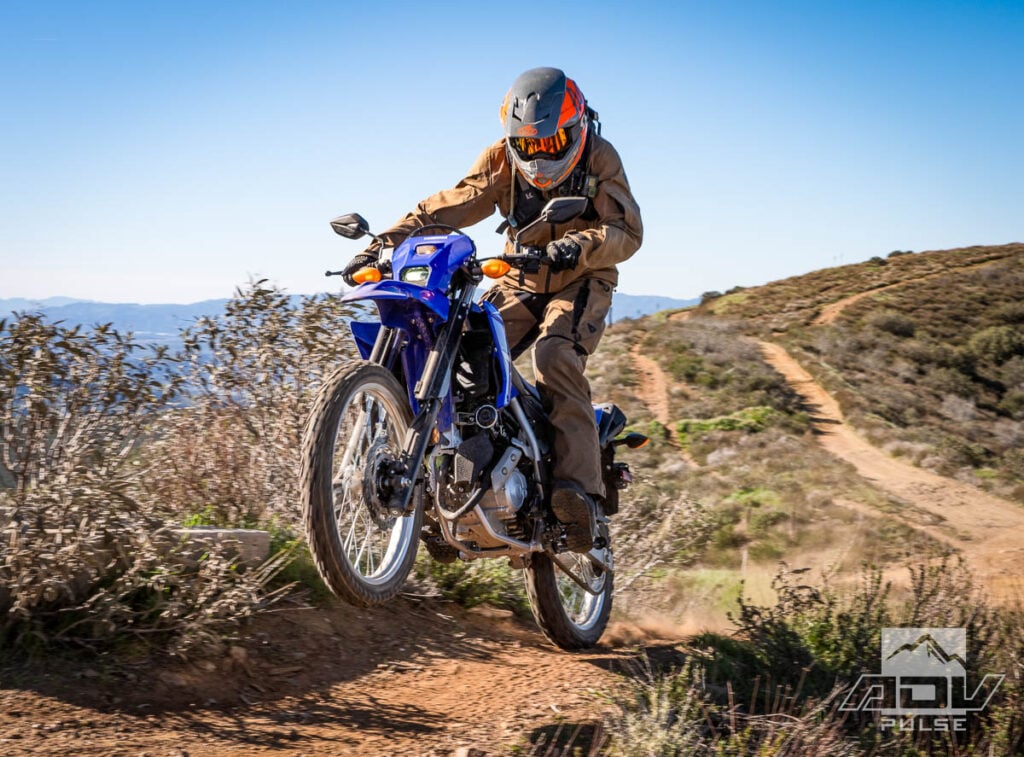
Small‑bore dual sports have always played an outsized role in bringing new riders into the fold, and Yamaha’s return to the 125cc street‑legal enduro segment couldn’t come at a better time. With the cost of motorcycles continuing to climb — and disposable income for young riders going the opposite direction — approachable, affordable machines are more important than ever. The new 2026 Yamaha WR125R arrives as exactly that kind of gateway bike: unintimidating, economical, and simple, yet packed with enough modern engineering to stand out in a category that’s often defined by bare‑bones outdated hardware.
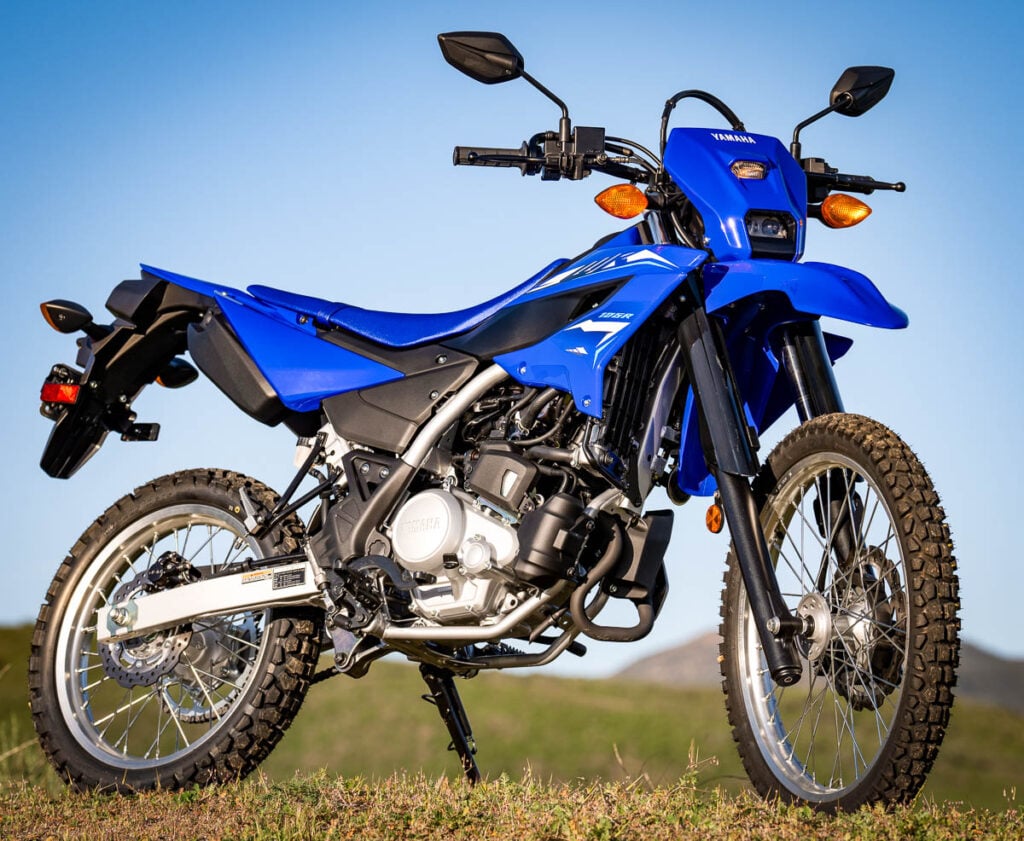
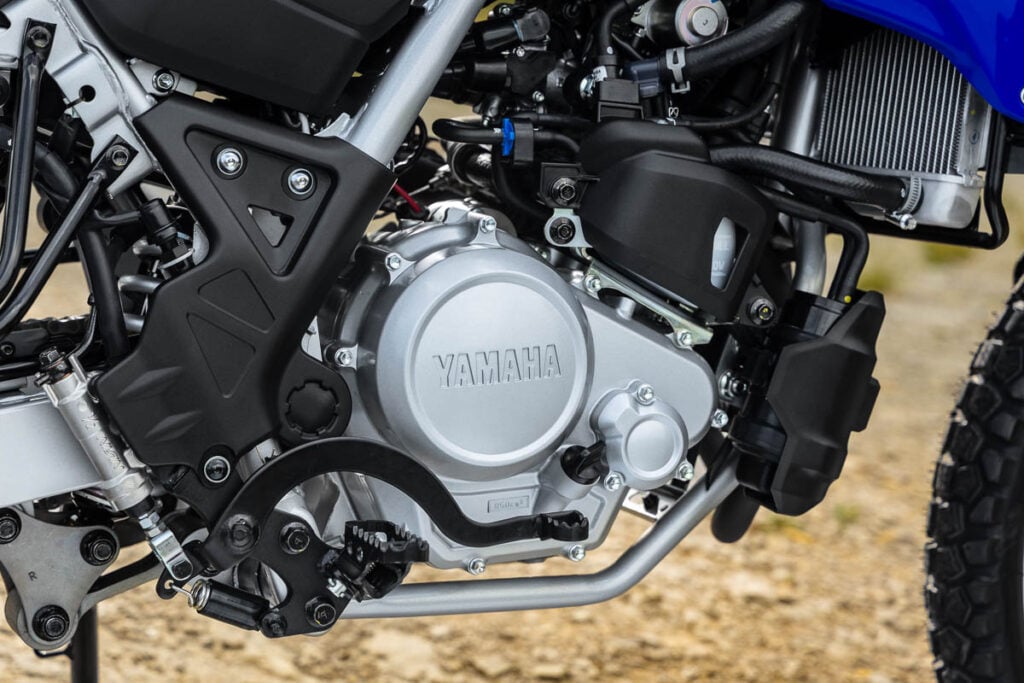
What makes the WR125R stand out in this sub-250cc, entry-level dual sport class isn’t just that it’s a fuel‑injected, liquid‑cooled single with a 6‑speed gearbox. Its real party trick is Yamaha’s Variable Valve Actuation (VVA) system, a technology usually reserved for far more expensive machines. VVA allows the engine to switch to a more aggressive cam profile at higher RPMs, letting in more air and fuel for stronger top‑end pull, while maintaining a milder, torque‑friendly profile at lower revs. The result is a modest but spirited 15 horsepower at 10,000 rpm, not a figure that will overwhelm anyone, but about 70% stronger than a Honda Trail 125 and roughly 20% more than the XR150L, with torque coming in at 8.1 ft‑lbs at 6500 rpm. Pair that with Yamaha’s claim of 96 mpg and a 2.1‑gallon tank, and the WR125R promises real range for riders who want to explore beyond the local OHV park.
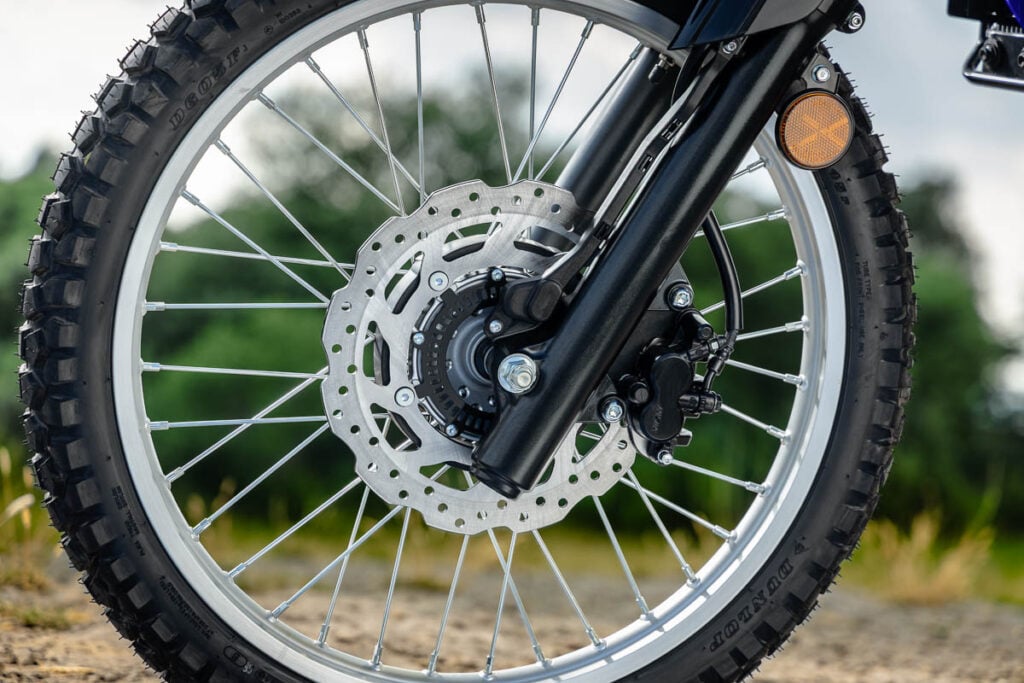
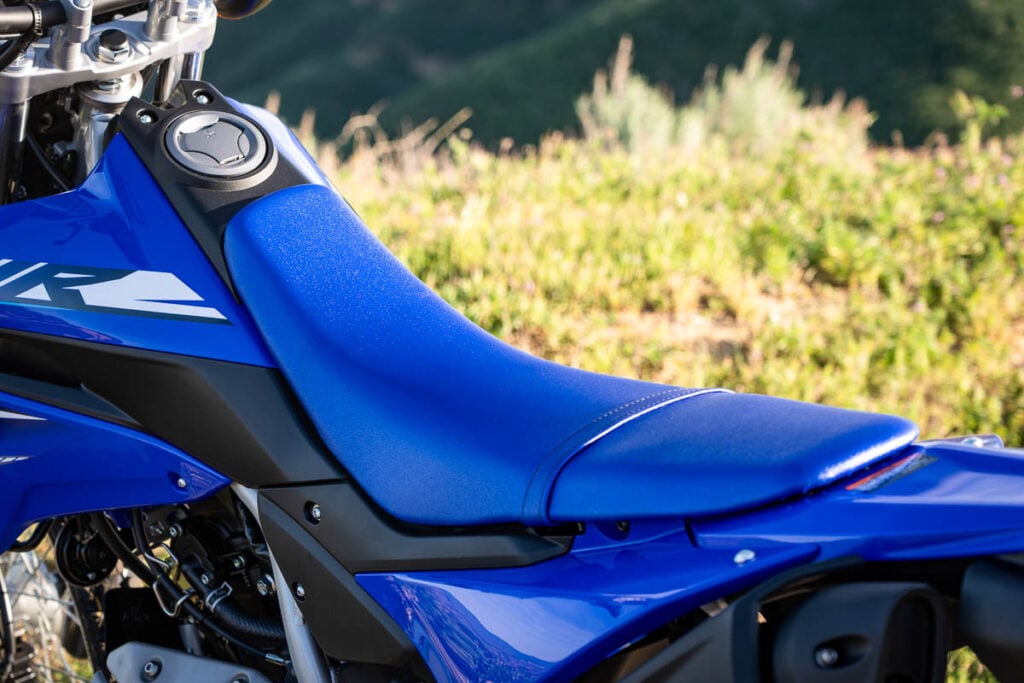
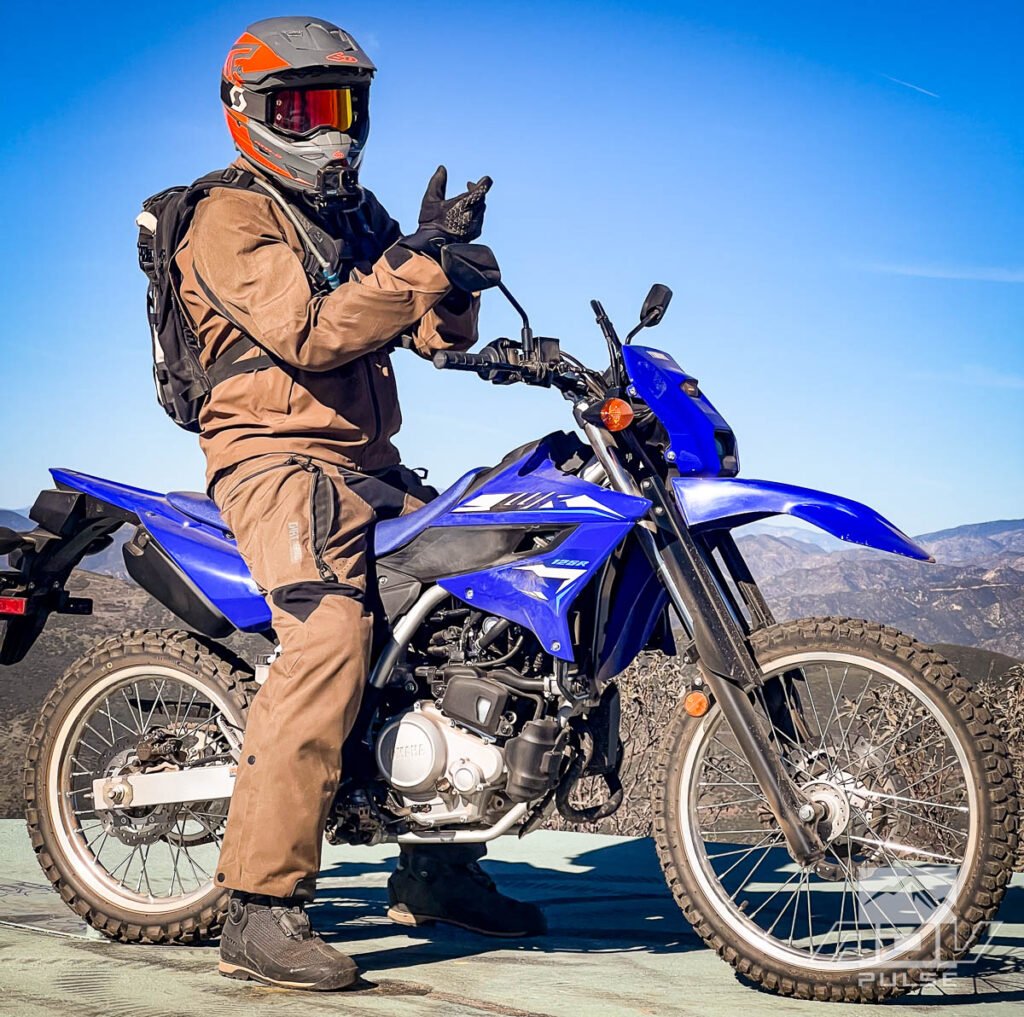
Underneath the tech, Yamaha built the WR125R on a relatively solid chassis for a bike at this price point. A semi‑double cradle steel frame supports a 41mm KYB fork (beefier than the pricier Kawasaki KLX230) and a KYB Monocross linkage rear shock. Wheel travel on the non-adjustable suspension (except shock preload) measures 8.5 inches up front and 7.4 inches in the rear, backed by 9.4 inches of ground clearance. Off‑road geometry comes standard with 21/18‑inch wheels wrapped in Dunlop D605 50/50 dual sport tires, while the serrated footpegs aim to give riders confidence on varied terrain. Seat height for the flat enduro-style saddle is listed at 34.4 inches, tall enough for proper off-road ergonomics but still approachable for most beginners.
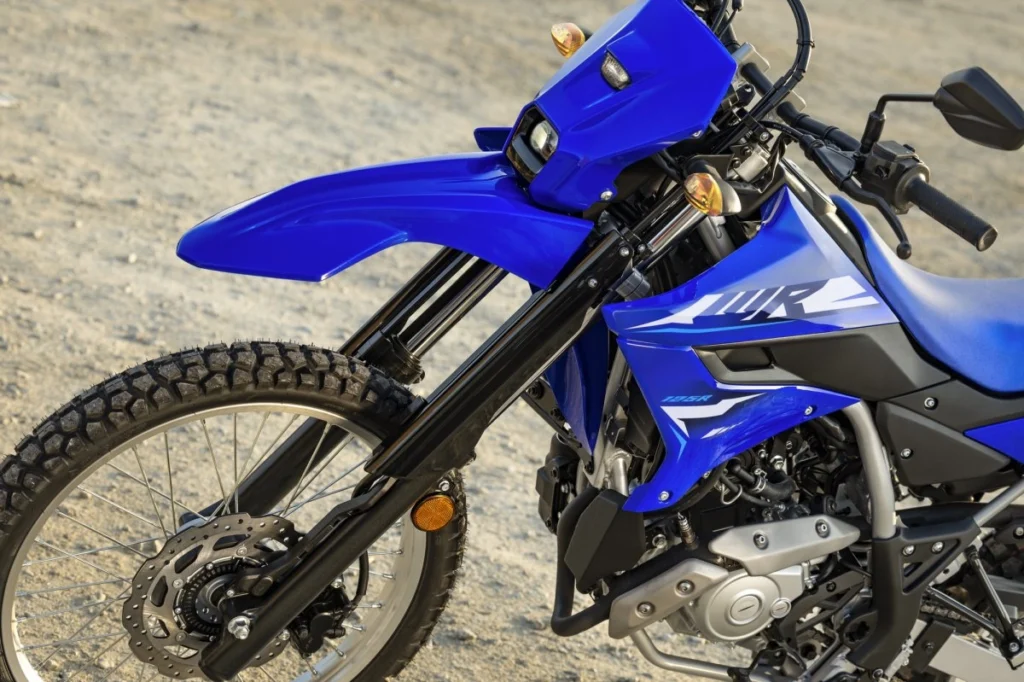
Braking is handled by Nissin, with a 267mm front disc and 220mm rear, and Yamaha includes ABS — though only on the front wheel and without an ‘off’ switch or an off‑road-specific mode. Lighting is modern, with a dual‑lens LED headlight paired with a halogen running light above it. Interestingly, the tail light and bulbous turn signals appear to be borrowed from a 2023 Tenere 700.
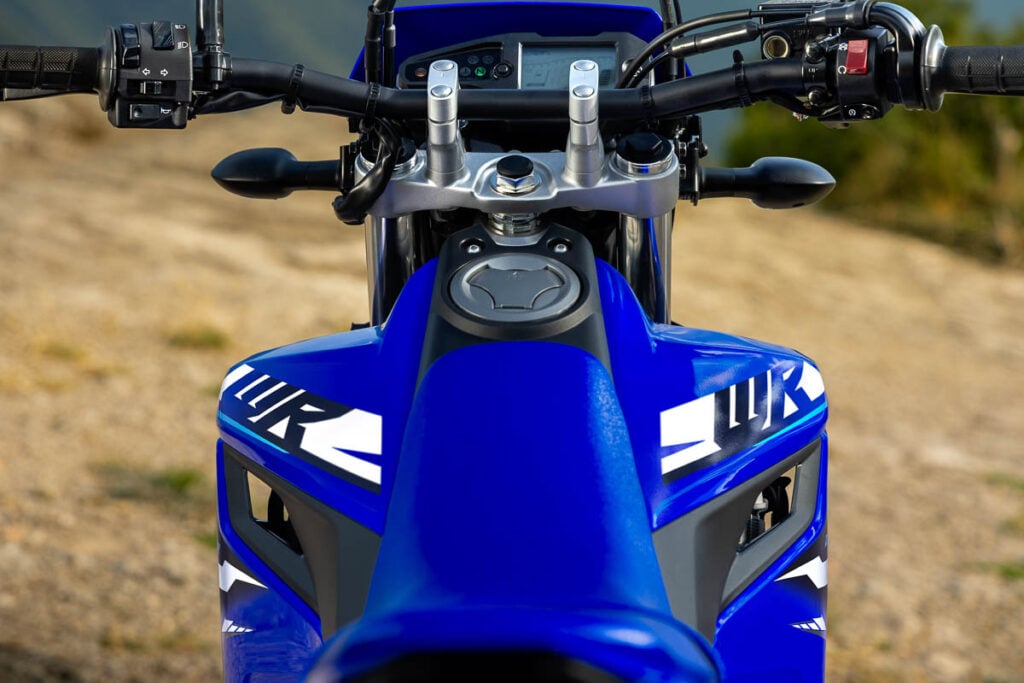
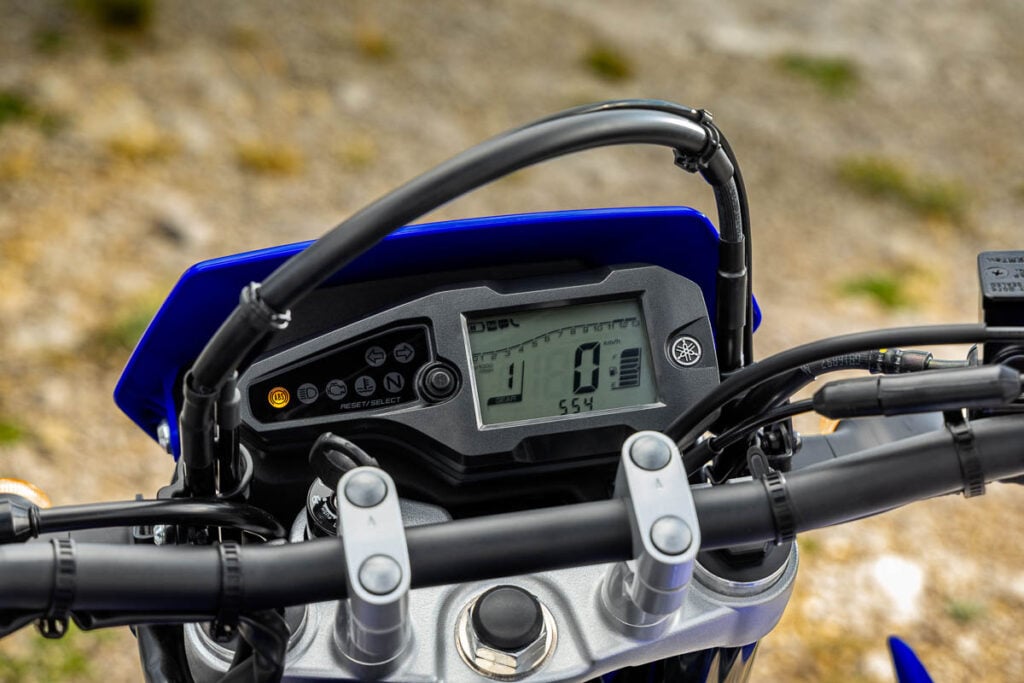
The cockpit is simple but surprisingly well‑equipped: Bluetooth connectivity comes standard through Yamaha’s Y‑Connect app, enabling call notifications, maintenance tracking, ride logging, and battery‑status monitoring. In addition, the LCD dash displays real‑time and average fuel consumption, a tachometer, tripmeter, clock, fuel gauge, and even a VVA activation indicator that acts like a turbo boost gauge. There’s no USB charging port but it does come with a lockable tool compartment on the right side that’s convenient if you need to stow away valuables, and there’s enough room to add a few extra tools.
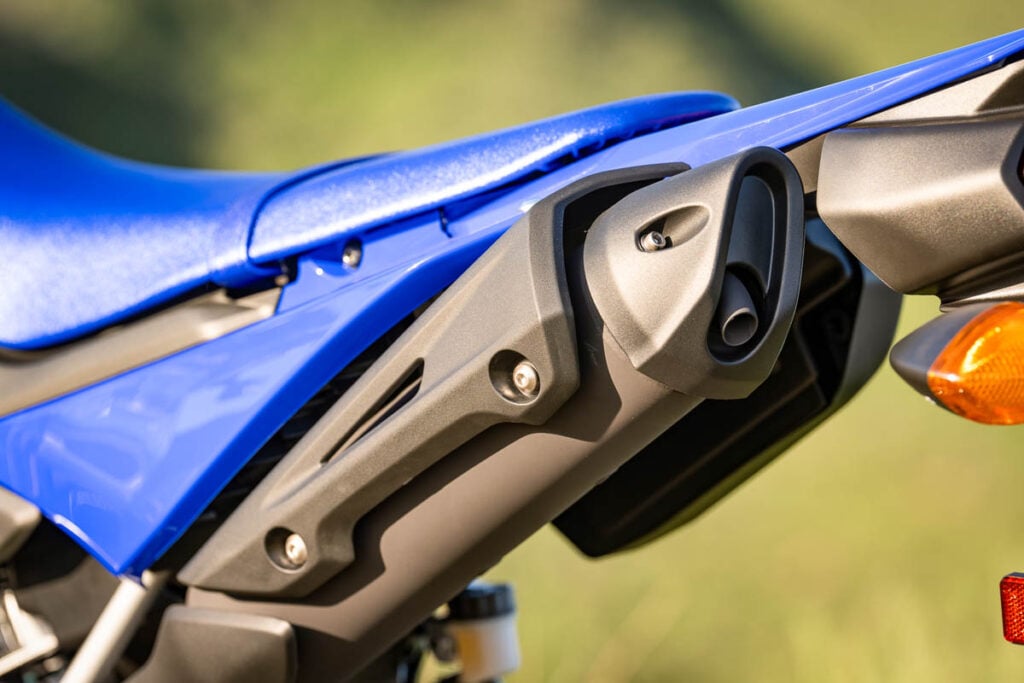
At 304 pounds wet, the WR125R isn’t the lightest small‑bore dual sport, but the added weight comes from its liquid‑cooling system, single catalytic converter, and other emissions hardware — tradeoffs required to deliver modern performance and EURO-5 efficiency. Oil changes are every 2,000 miles, so it’s something new riders may want to learn how to do on their own but at least the first valve check interval isn’t for 12,000 miles.
With its $3,999 MSRP, the WR125R targets new riders, commuters, and anyone looking for a fun, low‑cost second bike, but this model’s backstory adds some interesting context. Yamaha previously sold a WR125R in Europe from 2009 to 2014, a market where A1 licensing restrictions make 125cc machines a necessity. Bringing it to the U.S. is a different story though. Here, there are no displacement limits for a motorcycle license, and the landscape is dominated by big freeways that require at least 150ccs to travel on. So the big question is why did Yamaha decide to bring this bike now? And whether this little dual sport, with its accessible price point and approachable performance, fills a gap that’s been underserved in the American dual‑sport market? That’s what I aimed to find out as we headed out for our first ride at the WR125R launch held in the foothills just north of Los Angeles.
On The Street
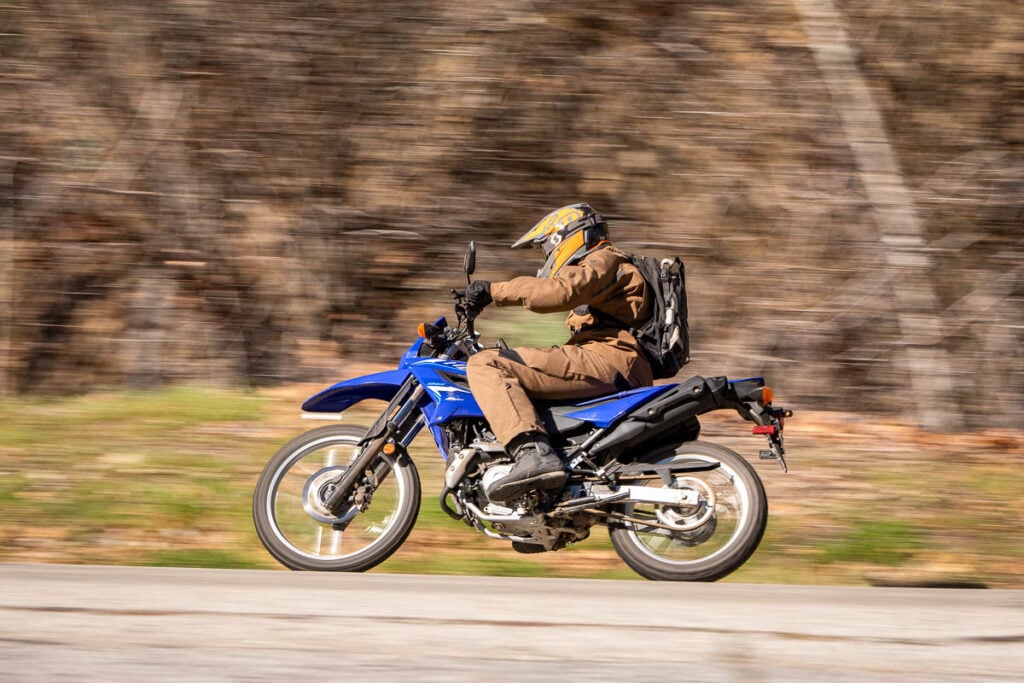
Cruising around town, the WR125R feels livelier than you might expect for a 125cc four stroke. Yamaha’s VVA system is front and center in the experience, and you can watch it happen in real time: the dash shows the VVA indicator climbing as the engine passes the 7,400 rpm mark. When revving it at a standstill you can actually hear a faint mechanical click as the cam shifts from its low‑rpm lobe to the high‑rpm profile. Out on the road, that transition is even more noticeable. The bike pulls cleanly through the midrange, but once the VVA kicks in it wakes up and delivers its strongest drive in the upper revs. It’ll spin all the way to 13,000 rpm, though the power starts tapering off around 11,000.
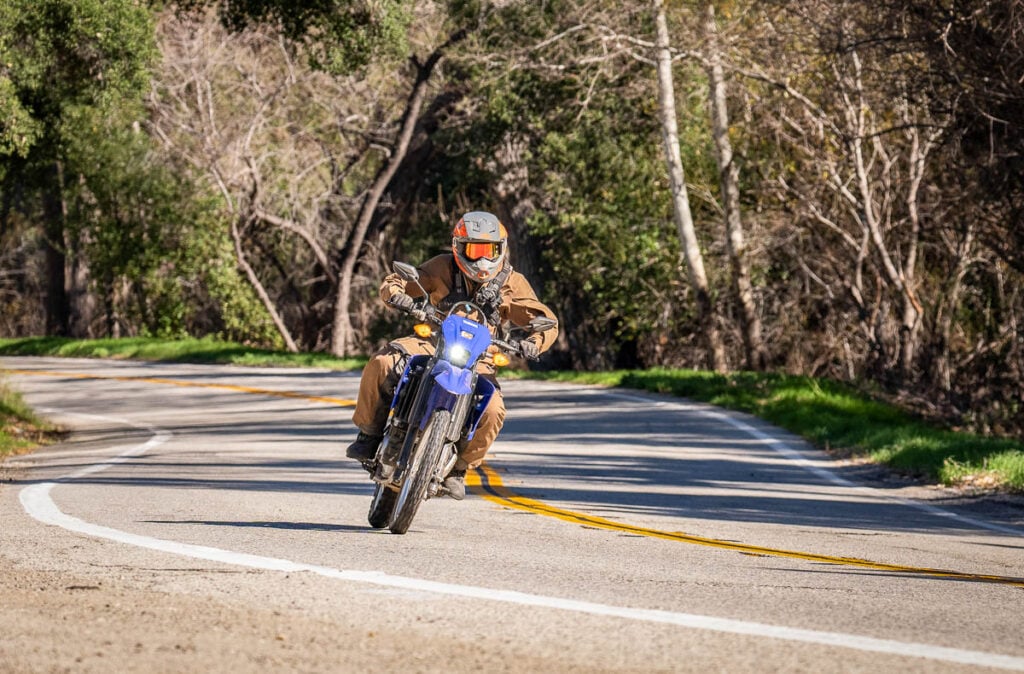
In practical terms, that means the WR125R has enough steam for city traffic and most backcountry roads, but it’s still a 125 at heart. Compared to a 250 or 300cc single, it’s noticeably down on power. Although, it’s also a lot of fun trying to squeeze every ounce of power out of a small engine.
On a slight uphill grade, I saw an indicated 52 mph, and on flat ground it settled into a comfortable 54 mph cruise with my 210-pound self sitting on it. Using a race tuck and a bit of downhill assistance, I managed 70 mph, and one test rider using a draft squeezed out 74 mph. Achieving those numbers was entertaining, but it also underlines the bike’s limitations: this is not a freeway machine, and at higher speeds there’s a noticeable buzz through the bars that reminds you you’re wringing out a small single.
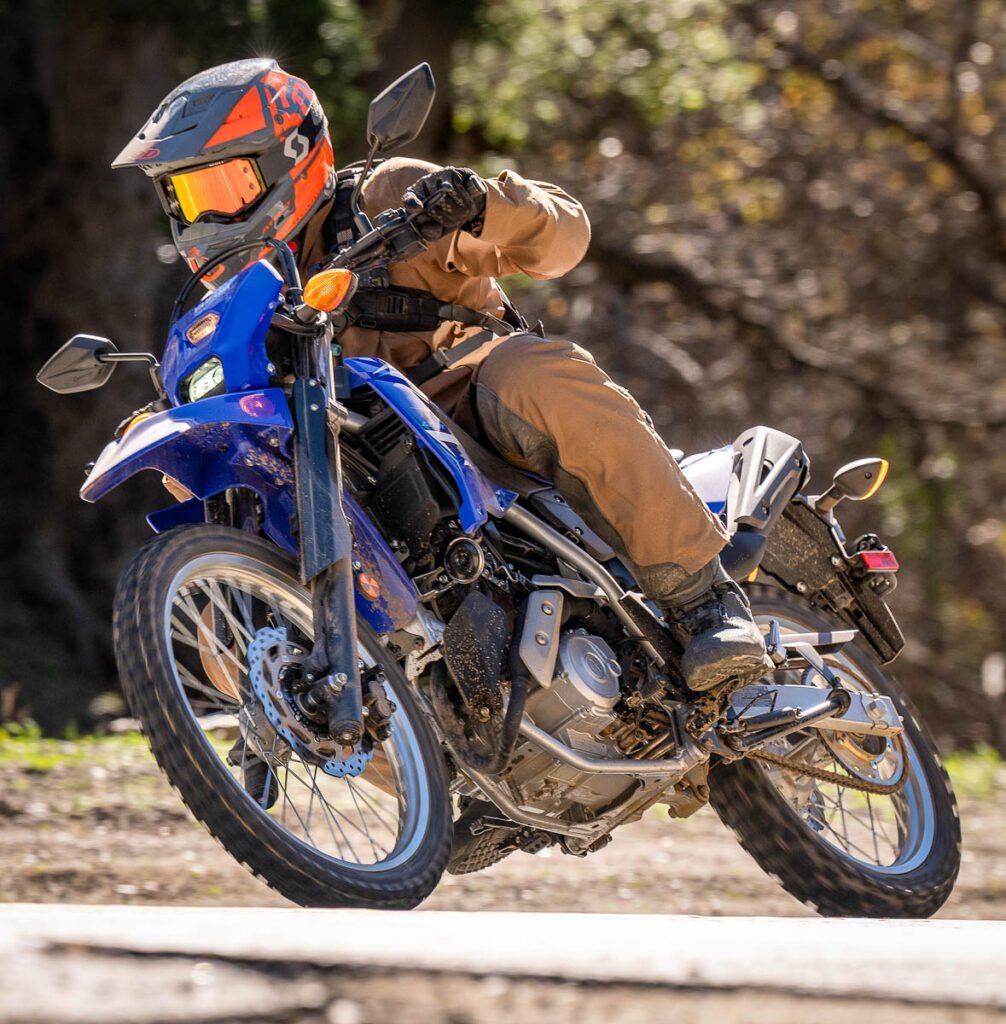
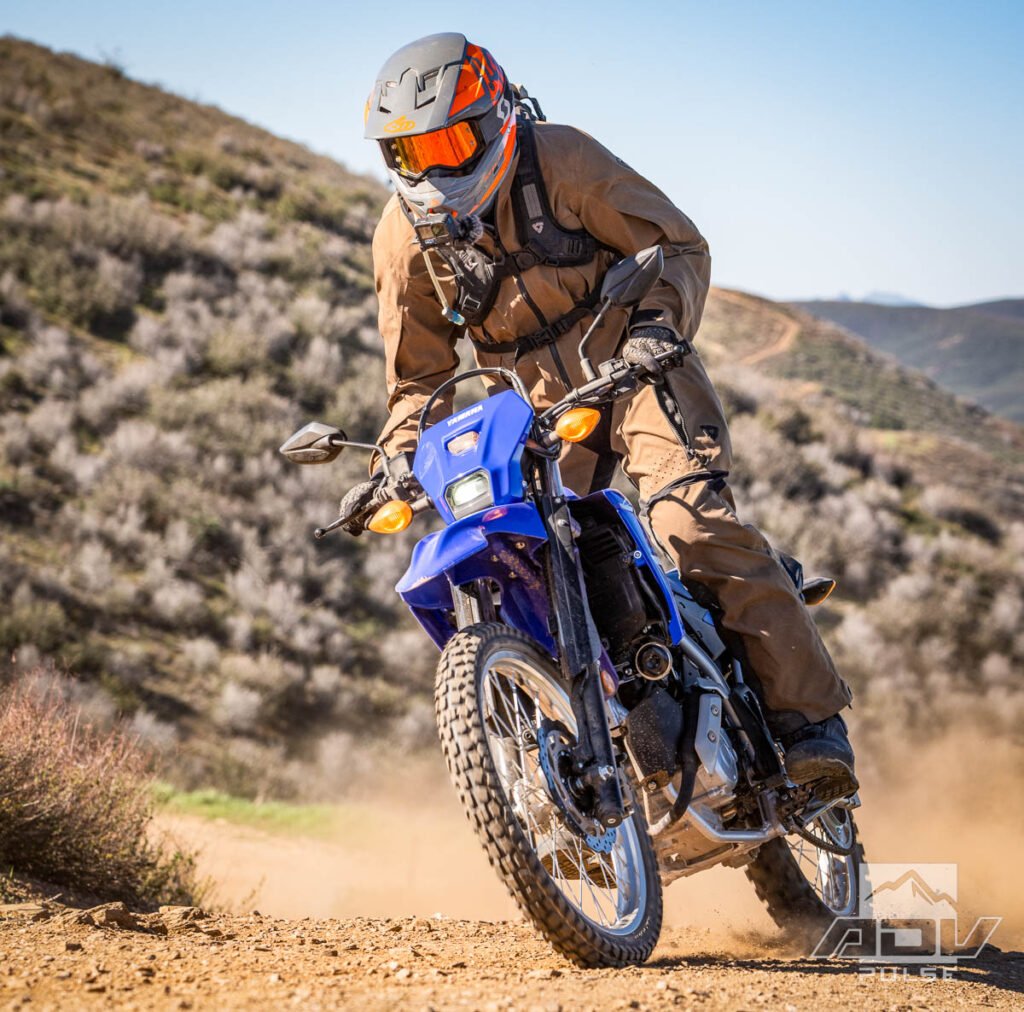
Ergonomically, the WR125R feels a bit more like a full‑sized dirt bike than a shrunken trail bike. The bar position sits a little closer to the rider due to the shorter wheelbase, but the overall bar height is right in the enduro range, and the 34.4‑inch seat height keeps you perched on the bike rather than sunk down in it. As far as the knee bend, I was surprised it didn’t feel very cramped at 6’2” sitting in the center of the seat. The seat is fairly comfortable and I didn’t get any discomfort during a full-day’s ride that included a fair amount of sitting.
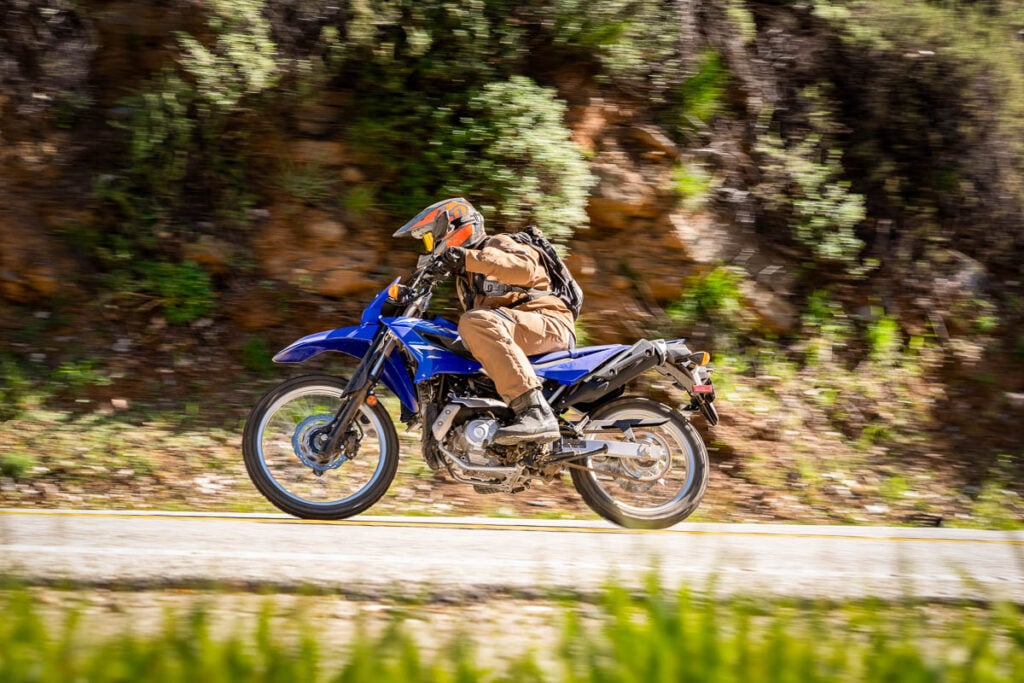
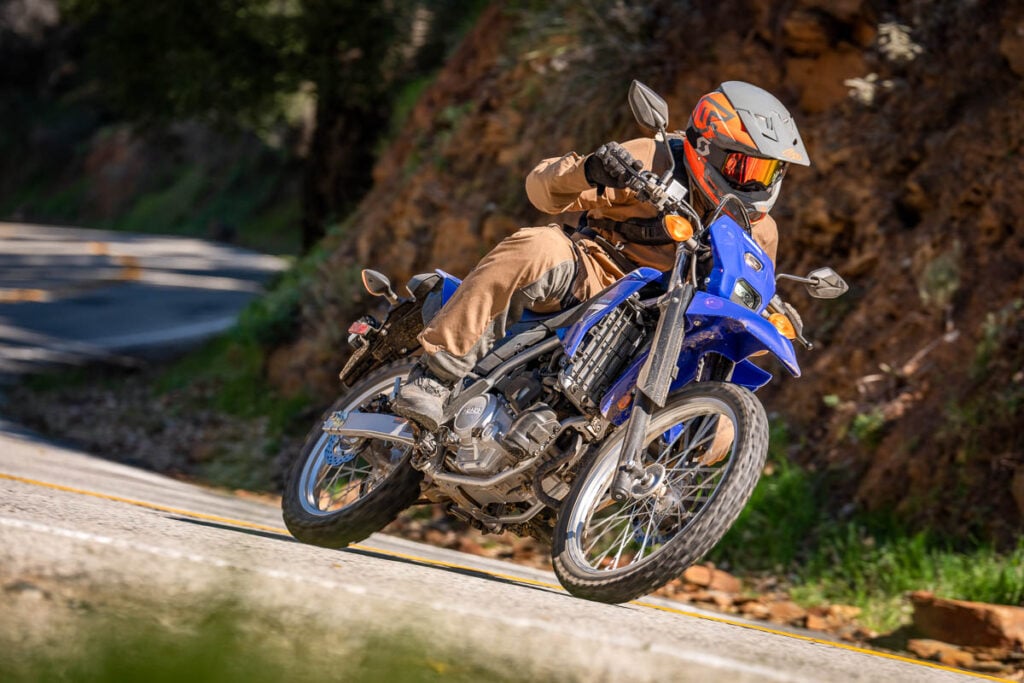
Where the WR125R shines is in agility and grip in the turns. The braking feel and power was reasonably good. Not performance brakes by any measure but they were more than adequate for this small machine. Overall it feels light, maneuverable, and genuinely fun to zip around on twisty asphalt or squeeze through traffic in the city. As a commuter or errand‑runner, it’s the kind of bike you could slap a top box on and instantly turn into a two‑wheeled grocery getter. The tradeoff is versatility. Without freeway capability and with limited power for steep hills, riders in hilly areas may find themselves constantly working the gearbox to keep pace with traffic. You are riding full throttle most of the time and if you need to pass a slow moving truck, you’ll need a long passing lane or you’re probably going to have to wait until they pull to the side. It’s not practical for any long-distance travel at speeds above 50mph but for linking up trails, exploring cities and rural backroads, the WR125R feels at home — playful, friendly, efficient, and with just enough power.
In The Dirt
Off‑road, the WR125R feels less like a budget trail bike. The standing position is natural and upright, with bar height that works well for taller riders without forcing a hunch, even if the bars sit a touch close due to the shorter wheelbase. The seat height strikes a nice balance: at 6’2″ I can get both feet down with a bend in my knees. For shorter riders, Yamaha’s optional low seat (‑1 inch) should make it more approachable. The seat itself has a mild contour and a gentle rise into the tank that still lets you slide forward easily to weight the front wheel. The footpegs are on the small side though, so long stints standing may fatigue your arches.
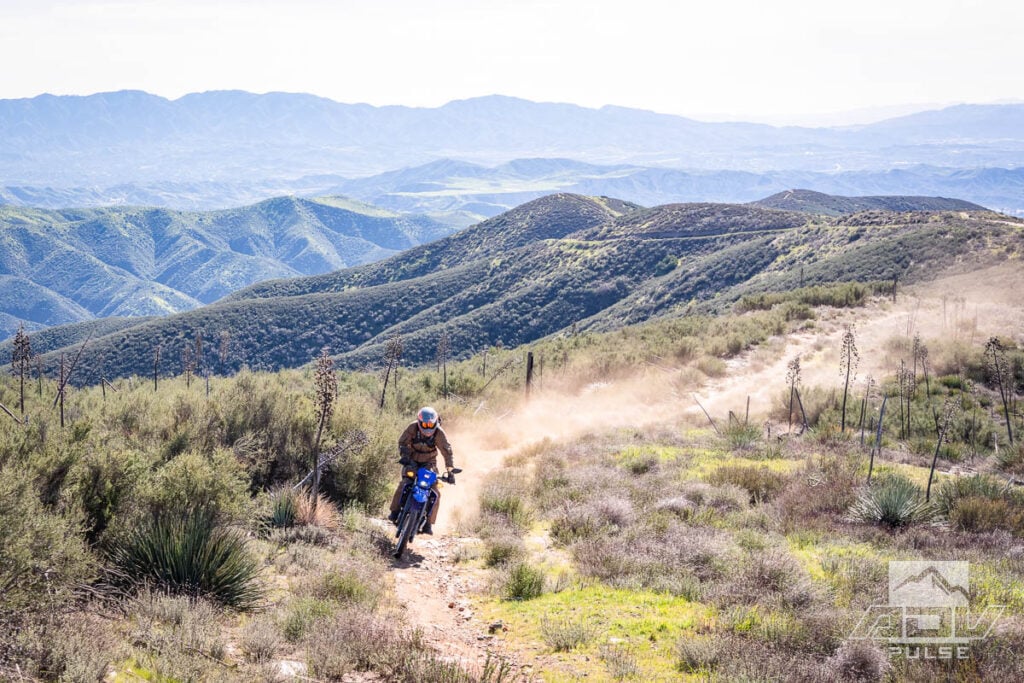
With only 125cc on tap, the WR125R turns even moderate hill climbs into a fun technical exercise. You can’t rely on brute force; you have to plan your line, build your momentum, and stay wide open on the throttle. Do that, and the bike will claw its way up surprisingly challenging terrain. First gear is low enough to tackle steep climbs without clutch abuse or fear of bogging, while second gear works well as you hit it with speed. Lose momentum, though, and it drops off quickly—this is a machine that rewards finesse and skill over aggression.
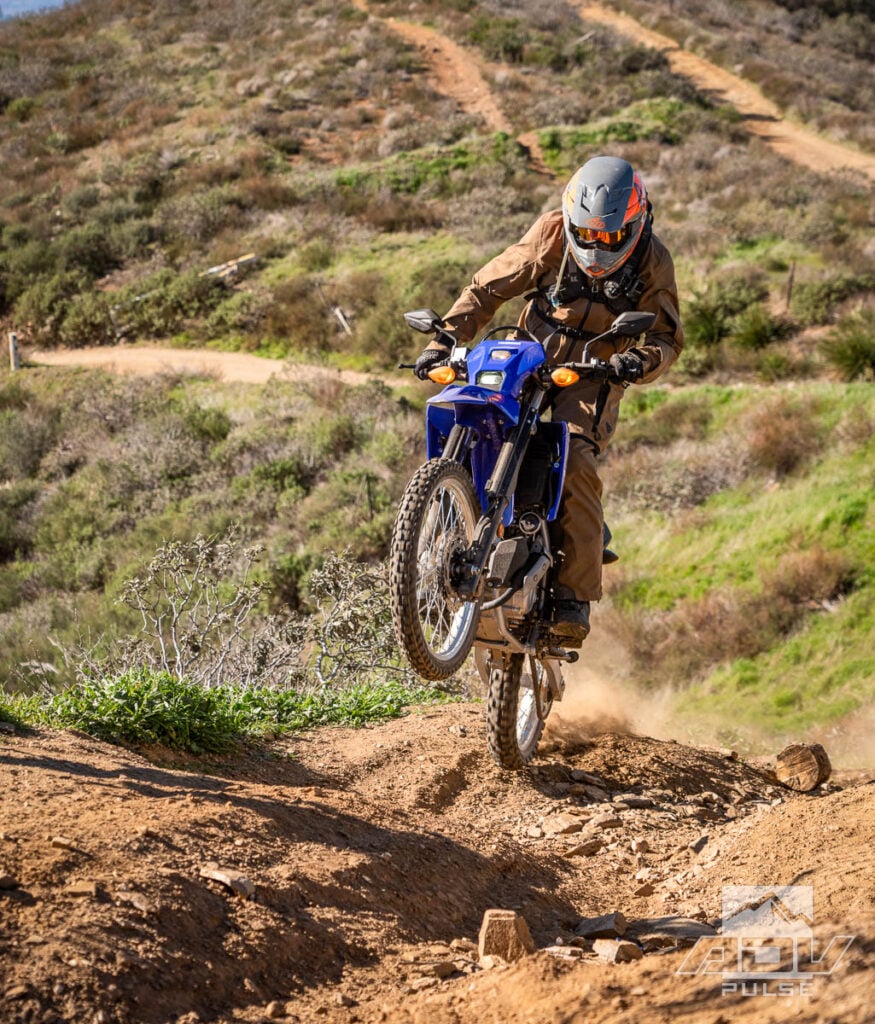
The mild power also means the front wheel doesn’t come up without intent. To loft it, you need to be going slow, build revs, and pop the clutch. It’ll do small wheelies, but only if you intend to—exactly what you want in a beginner‑friendly dual sport. The bike won’t surprise a new rider with unwanted drama. Even the ABS leans toward the conservative side, activating earlier than an experienced rider might prefer and preventing partial front‑wheel slides. But for the WR125R’s target audience, that’s a feature, not a flaw. On mild to semi‑technical descents, it keeps things composed without feeling overly intrusive, and it’s the kind of safety net that can prevent the classic low‑speed front tuck that sends many new riders home discouraged.
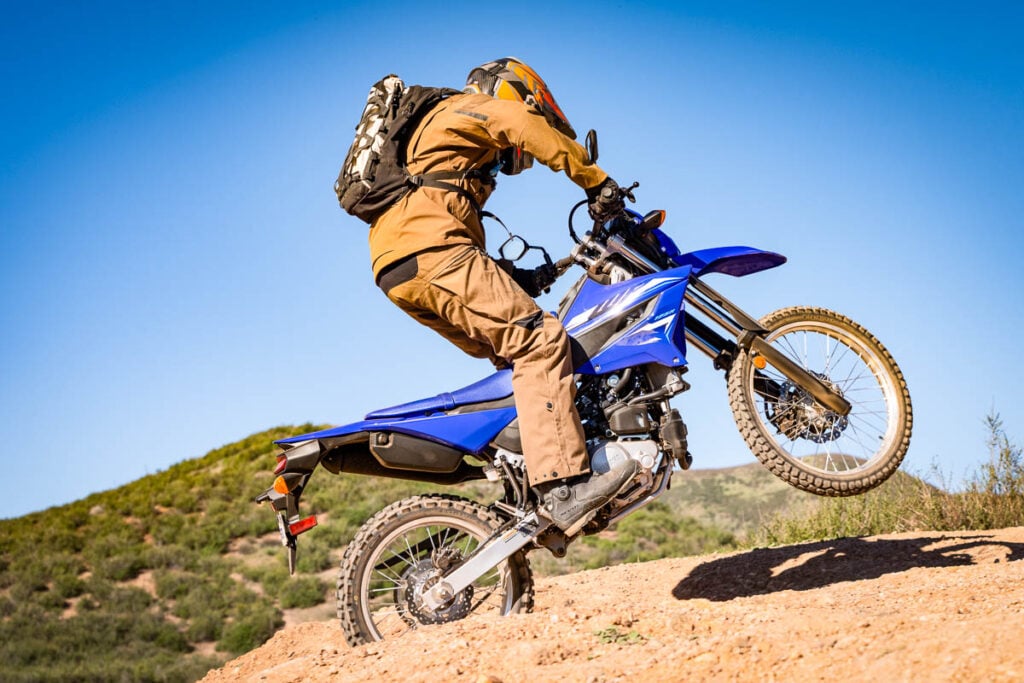
Suspension performance is one of the WR125R’s biggest surprises. Yamaha kept the suspension simple—preload only on the shock—but the stock damping is well‑tuned, playful, and supportive for the kind of terrain this bike is built for. The KYB components don’t feel cheap or underdamped, and there’s no clunking over sharp‑edged hits. With 8.5 inches of fork travel and 7.4 inches in the rear, the bike soaks up embedded rocks, dips, and chop with a smooth, controlled feel. The 41mm fork adds some stability when the pace picks up, and the 21/18 wheelset helps the bike roll over obstacles that would unsettle smaller‑wheeled machines. Even with the shock preload set in the middle of its range (likely too soft for me), bottoming was rare unless you really got both wheels off the ground. Ground clearance is solid as well; I tapped the frame rails lightly in rocky sections but never smacked down hard, and the bike cleared a few decent step‑ups without drama.
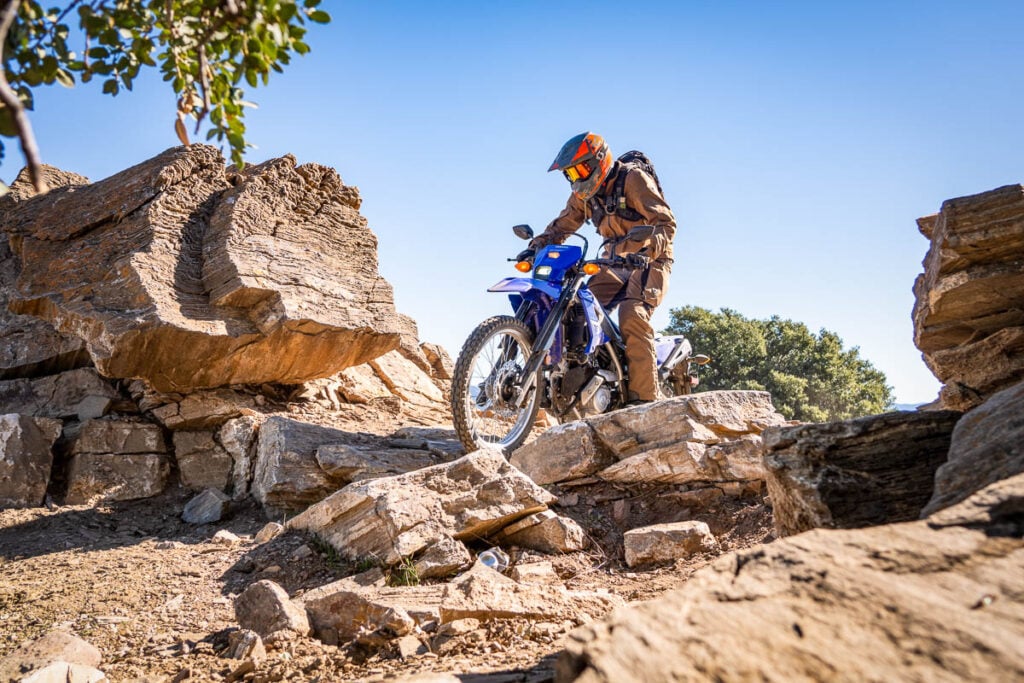
Compared to muscling a larger dual sport, this bike preserves energy a bit more and encourages you to play—changing lines, hopping over ruts, and bouncing through rock gardens with minimal effort. It’s genuinely hard to “over‑ride” the chassis. The limiting factor is typically the engine’s power, not the suspension, and that’s part of the ‘charm.’ On a bigger bike, you can get into trouble quickly with the twist of the throttle. On the WR125R, you have to build speed gradually so it’s harder to get caught out by surprise. If you do fall behind your buddies after making a quick gear adjustment, you’ll have to work hard to reel them back in again.
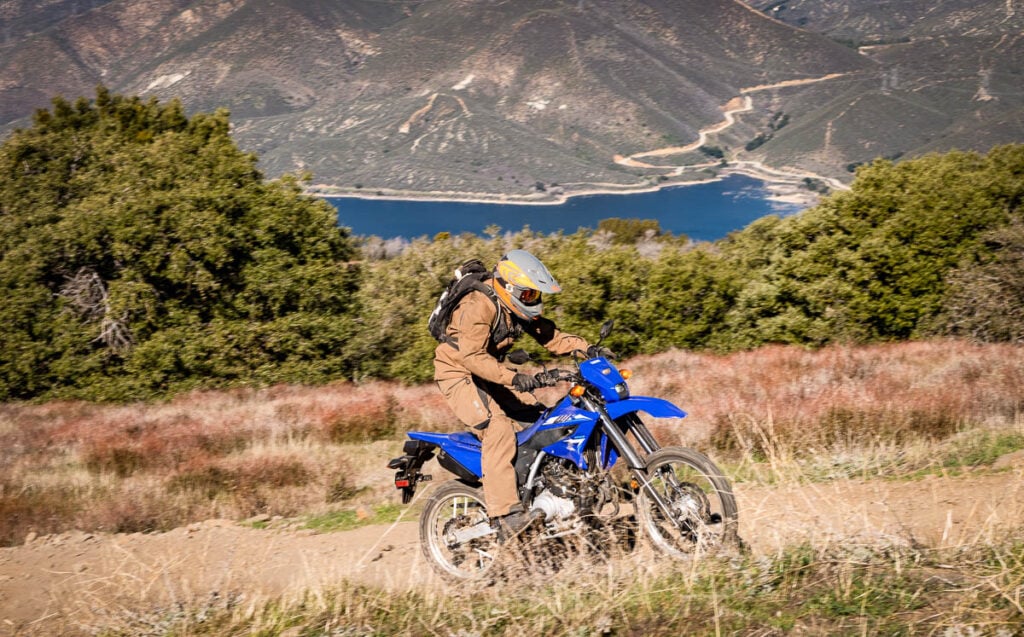
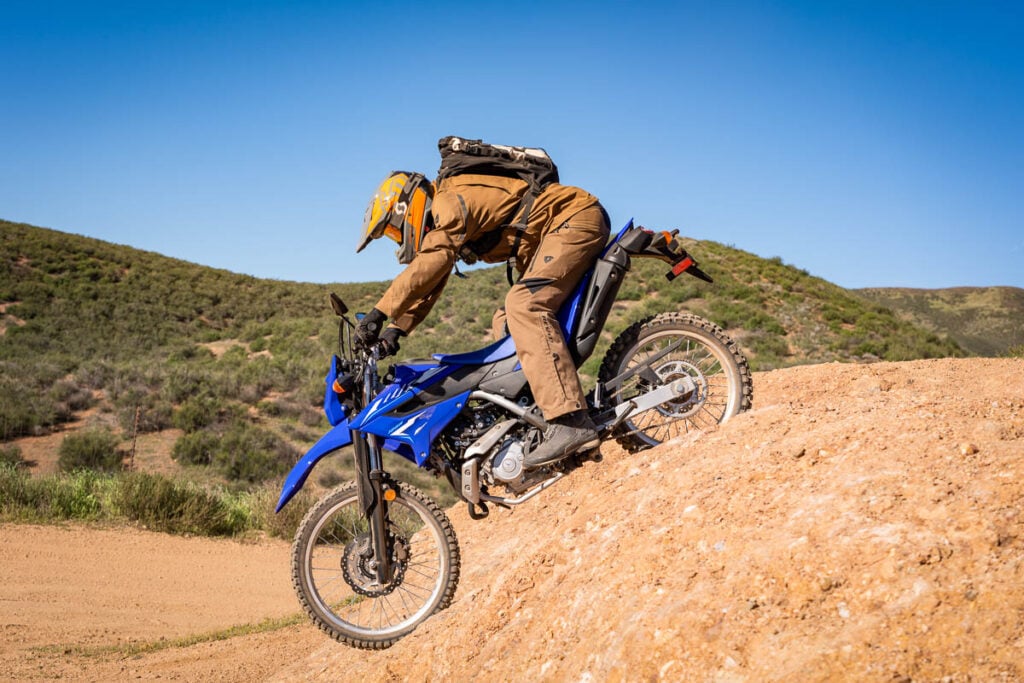
Despite the WR’s wet weight, it’s light on its feet with predictable, confidence‑inspiring traction. The Dunlop D605 50/50 tires are a good match for the WR125R, offering plenty of grip on loose rock and semi‑slippery terrain. It’s actually almost impossible to spin up the rear tire unless you’re trying, and the bike holds a clean line without pushing the front. Braking performance is solid for light‑duty off‑road use, with good feel and no fade. The rear brake has good feel before lockup, and while the front ABS can be a bit sensitive, it ultimately keeps new riders out of trouble. The only mechanical quirk I noticed was the shifter, which felt a bit finicky when trying to find neutral—something that may improve as the bike breaks in.
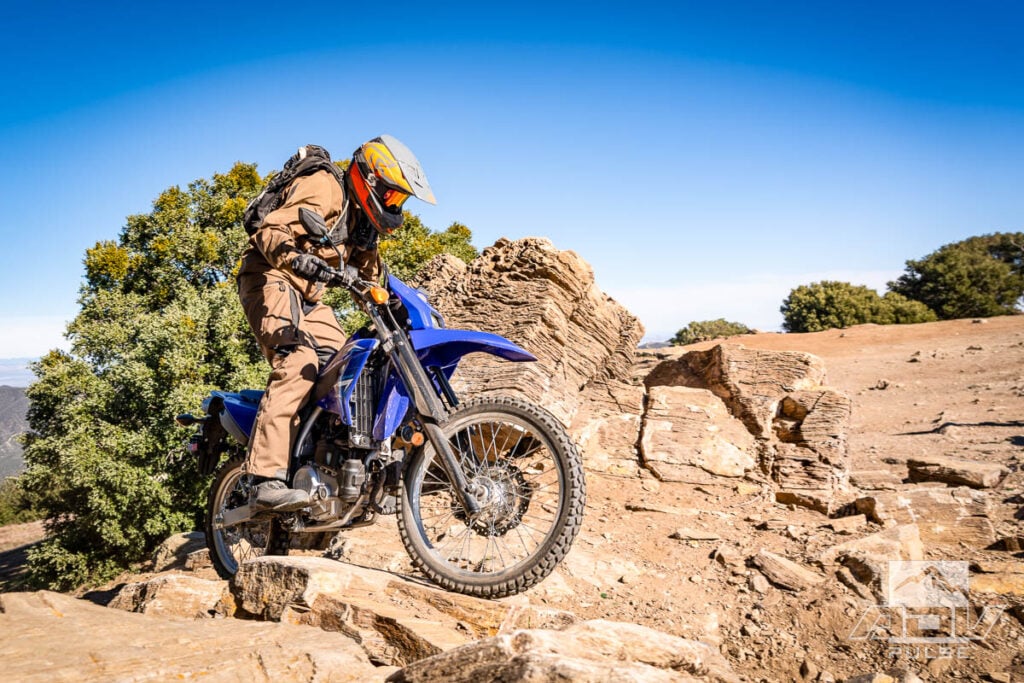
In short, the WR125R is a bike that teaches good habits on the trail. It rewards momentum, shift timing, body positioning, and efficient line choices. Speaking of efficiency, during my test I was getting 64 mpg in mixed riding conditions while being heavy on the throttle. I think a new rider will be amazed at what they can tackle on this machine and feel safe doing it, while an experienced rider can still have a blast wringing its neck. The terrain we rode during this test would give many intermediate riders pause on a larger bike like a Tenere 700, yet on the WR125R I think they would find it challenging and fun. Of course there’s no way to shut ABS off completely, but if that’s a dealbreaker, you’re probably looking at the wrong bike.
The Bottom Line
The WR125R is an interesting mix of modern tech, approachable performance, and real world affordability for new riders. Some may find the styling a bit quirky. The upper running light — a small halogen “eye” perched above the dual-lens LED headlight — doesn’t provide much light, but it gives the bike a distinctive look. I can already imagine the aftermarket stepping in though with a high‑output LED replacement nice for illuminating the trail. The fork protectors mounted high up on a conventional fork also look a bit unusual to me, but they get the job done.
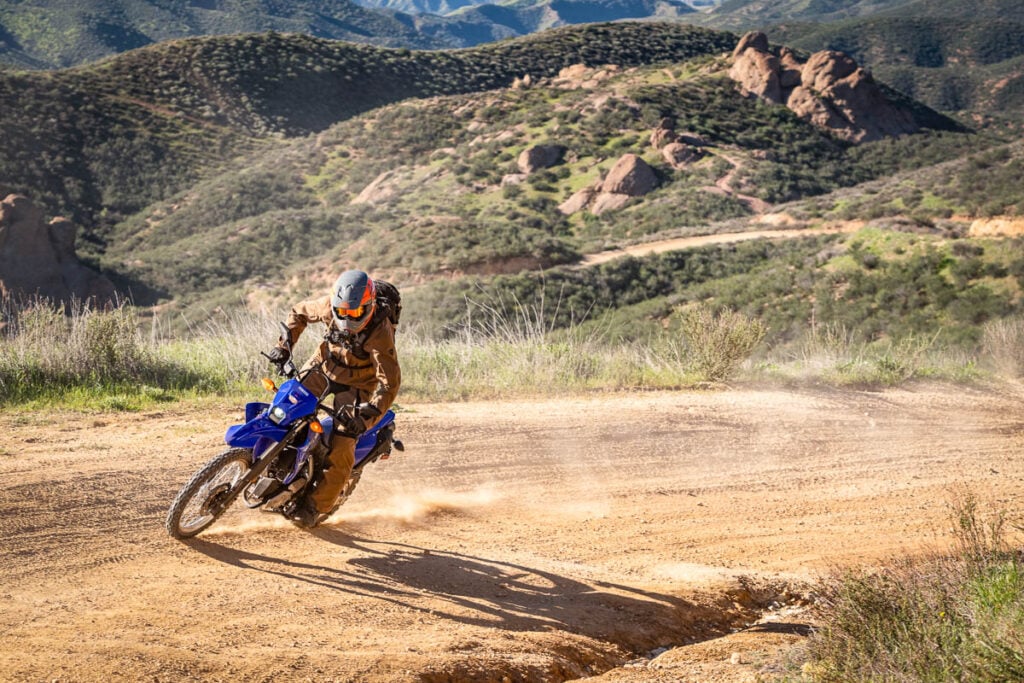
There’s no getting around that it’s limited on power. Bumping displacement to 150cc would unlock freeway legality and a larger potential market here in the states. Hand guards and a skid plate would also be appreciated as standard equipment, and I think not including a USB charging port for young riders tethered to their phones is a miss. Although at this price point, it’s hard to fault Yamaha for keeping the core package simple. You can criticize the weight but the extra mass didn’t seem very noticeable while riding it.
Where the WR125R finds its footing is in the value proposition. Stepping up to a KLX230S ABS at $5,499 is a 50% jump in price, and moving into CRF300L territory is even steeper. Yes, Honda’s XR150L undercuts the Yamaha by $600, which is significant but you give up a lot for that savings: a rear drum brake, a carbureted air‑cooled engine with even less power, smaller wheels and reduced suspension travel.
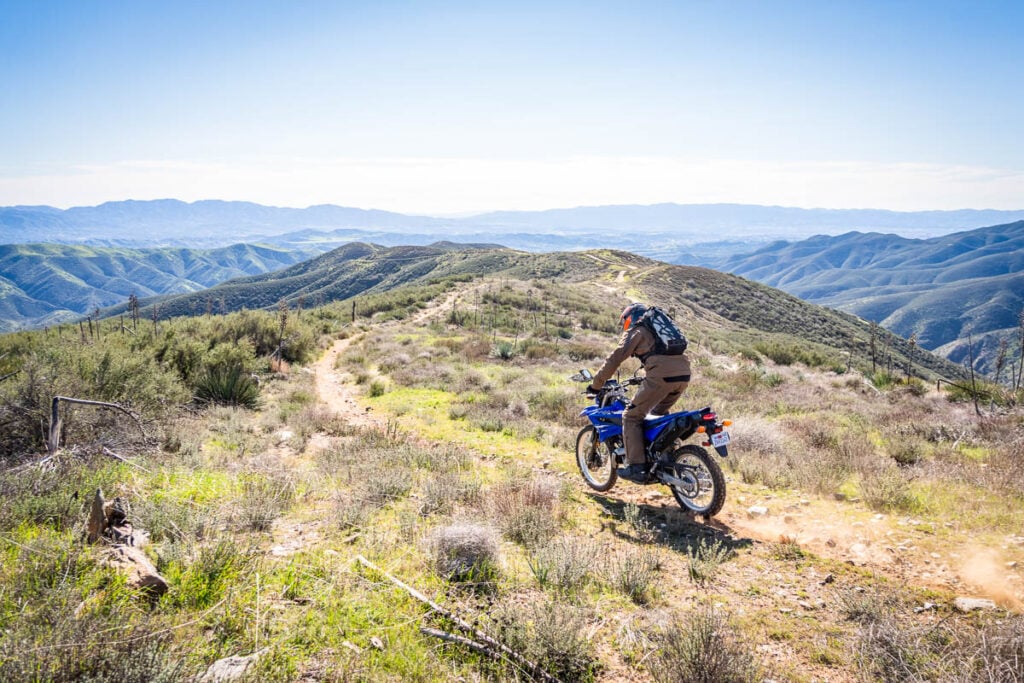
Could it be used as a lightweight ‘adventure bike’? If it’s all you got, why not. Add some soft luggage and a GPS, and it’s capable of short‑range moto camping trips or weekend explorations. The more you weigh it down with camping gear and extras supplies though, the more it’s going to sap its limited power — so learn to pack light! Long‑range U.S. highway travel isn’t practical, but off‑road‑focused weekend adventures are well within its wheelhouse. Alternator output is a little limited at 175 Watts if you plan to run heated gear, heated grips, a GPS and auxiliary lights but it’s doable if not all at once.
Ultimately, the WR125R is about accessibility — financially and physically. It’s a bike for new riders dipping their toes into dual‑sport riding, for commuters wanting low-cost transpo they can explore trails with on the weekend, and for experienced riders who want a fun, affordable second machine for camping trips, teaching their teenagers how to ride and running errands around town.
Yamaha’s decision to bring a modern, budget-friendly 125cc Dual Sport to the U.S. seems like a welcome move at a time when young riders face challenges of rising costs and limited disposable income. Not every new rider needs—or can afford—a “real” dual sport that might cost $1,500 to $2,000 more. Not everyone has the mechanical know-how to fix and maintain a decades-old machine with a questionable maintenance history. And not everyone wants to wait for “someday” to start riding. Payments on the WR125R would be somewhere around $75 per month, with insurance around the $50 per month range. That’s fairly affordable, even for a college student living in their parents’ basement.
I got my start at age 15 on a 7-horsepower 50cc street bike, and in hindsight, I’m grateful I didn’t begin on something larger. Learning on a forgiving, unintimidating, less-powerful machine taught me skills that stuck with me and it probably saved me from a few consequential get offs at an age when I wasn’t making the best decisions. The WR125R fits that same mold. It’s a gateway, a confidence builder, and a reminder that motorcycling doesn’t have to be expensive or intimidating when getting your start. Machines like this WR125R make that first bike purchase a whole lot easier, and that’s good for the industry as a whole.
2026 Yamaha WR125R Specs
| Engine type: | 4-stroke, Liquid-cooled, SOHC, 4-valves, Single cylinder |
| Displacement: | 125 cc |
| Bore x stroke: | 52.0 x 58.7 mm |
| Compression ratio: | 11.2 : 1 |
| Maximum power: | 10.7 kW (14.5 PS) @ 10,000 rpm |
| Maximum torque: | 11.3 Nm (1.2 kgf-m) @ 6,500 rpm |
| Lubrication system: | Wet sump |
| Clutch type: | Wet, Multiple Disc |
| Ignition system: | TCI |
| Starter system: | Electric |
| Transmission system: | Constant Mesh, 6-speed |
| Final transmission: | Chain |
| Fuel consumption: | 2.3 L/100 km |
| CO2 emission: | 55 g / km |
| Fuel system: | Electronic Fuel Injection |
| Frame: | Semi double cradle |
| Caster angle: | 28°20′ |
| Trail: | 117 mm |
| Front suspension: | Telescopic fork, Ø 41 mm |
| Rear suspension: | link suspension, Swingarm |
| Front travel: | 8.5″ (215 mm) |
| Rear travel: | 7.3″ (187 mm) |
| Front brake: | Hydraulic single disc, Ø 267 mm; ABS |
| Rear brake: | Hydraulic single disc, Ø 220 mm |
| Front tire: | 90/90-21 Dunlop D605 (tube type) |
| Rear tire: | 110/80-18 Dunlop D605 (tube type) |
| Overall length: | 85″ (2,160 mm) |
| Overall width: | 33.1″ (840 mm) |
| Overall height: | 47.0″ (1,195 mm) |
| Seat height: | 34.4″ (875 mm) |
| Wheelbase: | 56.3″ (1,430 mm) |
| Ground clearance: | 9.4″ (240 mm) |
| Wet weight: | 304 lbs (138 kg) |
| Fuel tank capacity: | 2.1 gallons (8.1 L) |
| Oil tank capacity: | 1.1 L |
| Screen type: | LCD |
| Smartphone Connectivity: | MyRide |
| On-screen Navigation: | Not available |
| Starting MSRP: | $3,999 |
| Warranty: | 1 year (limited factory warranty) |
Gear We Used
- Jacket: REV’IT! Component 2 H2O
- Pants: REV’IT! Continent
- Boots: REV’IT! Expedition GTX
- Gloves: REV’IT! Massif
- Helmet: 6D ATR-3 Hex
- Goggle: Scott Prospect
Photos by Dave Schelske

Author: Rob Dabney
Rob Dabney started a lifelong obsession with motorcycles at the age of 15 when he purchased his first bike – a 1982 Honda MB5. Through his 20’s and 30’s he competed in off-road desert races, including the Baja 250, 500 and 1000. Eventually, his proclivity for exploration led him to dual sport and adventure riding. Rob’s never-ending quest to discover what’s around the next bend has taken him on Adventures in Latin America, Africa, Europe, Asia, and throughout the American West. As a moto journalist, he enjoys inspiring others to seek adventure across horizons both near and far.Related Stories
Related Stories
 Yamaha Announces A New WR125R Dual Sport For 2026 With a clear eye on attracting the next generation of dual sport and...
 Putting Yamaha’s Revamped 2025 Tenere 700 To The Test Yamaha’s Tenere 700 has been one of the most successful adventure motorcycles to...
 Next-Gen Husqvarna 701 Enduro First Ride Review Few single-cylinder powerplants have earned the kind of reputation KTM’s LC4 has built...
Popular Stories
Ducati’s Street‑Legal 450 Enduro Takes Shape Ahead Of 2026 Launch
Ducati’s push into off‑road competition is about ...
Yamaha’s Flagship Tenere 700 “World Raid” Is Coming To The US
Tenere fans rejoice! Yamaha is finally bringing...

British Couple Riding Through Iran Receives Harsh Prison Sentence
When Craig and Lindsay Foreman set off from Londo...

Putting Yamaha’s Revamped 2025 Tenere 700 To The Test
Yamaha’s Tenere 700 has been one of the most ...


Notify me of new posts via email
I think in this price range you are better off with an emoto. Don’t have to monkey with fluids and faster off line. I guess if you are doing an extended adv trip it would be more challenging. This bike feels so third world compared to so many of the new electric offerings.
Interesting. What are some of the e-moto models you are suggesting in this price range?
Rawrr Mantis X ~ $3600, Talaria Sting MX5 – $4,000, E Ride Pro SS ~ $4500, Sur-Ron Light Bee X $3500, Extreme Wheel ES -$3900 to name a few.
I see your point if you are looking for something that is strictly for off-road use. Although, I think a better comparison would be to the off-road-only Yamaha TTR 125 at $3500. The WR125R gives you real range and its a true dual sport. But with new street-legal kits and improved range, the e-bike option is looking more promising everyday though.
Range and licensing are legit arguments. I think most cities are rethinking ebikes though. In Denver scooters under 50cc’s are legal on the road and so there is an argument if you get pulled over on one that it is equivalent to a 50’cc moped. You need a OHV tag on forest service roads but you need those for ATVs too. In Colorado I don’t see anyone on 125cc bikes but I see tons of people on ebikes. Gotta stay relevant right?
Here in Southern California they are cracking down on those types of e-bikes. They are getting impounded left and right. If you put a pedal kit on them, then they pass as legal though. Zero recently came out with their X-Line and I hear there’s a new street-legal kit they just released. So we’ll be looking into those and other lightweight e-bikes that are “street legal” more in the future. But range is definitely something these manufacturers need to focus more on. Who needs 468 ft-lbs of torque on a motorcycle? What we need is at least 90-100 miles of real off-road range.
You would think California of all states would get it right. Make green options available for all. Zero is great but if they don’t get in line with pricing China is going to eat their lunch. Zero is a pioneer but they aren’t a leader anymore.
There is an argument to be made that not all riders need 90 – 100 miles of range. An economical e-moto that is fun, gets around town and can juke any car at the flick of a grip is a big market in most urban areas. No fluid changes, or gas, plug in over night and go? Get to the grocery store, work or school? That’s the future. The kids riding e-motos at 14 popping wheelies down the road are the future of the industry. Like it or not they are going to dictate what sells down the line. They aren’t going to be trading in their e-motos for a 125cc any more than our generation was going to get an old 1970’s harley for some off road racing vs a Honda or Kawasaki.