
ADV Destinations: White Rim Trail, Moab
A must-do loop in Moab for anyone exploring the backcountry on two-wheels.

Few places in the American Southwest capture the imagination of adventure riders quite like the White Rim Trail. This 100-mile loop through Canyonlands National Park is a journey that blends remote off-road riding with some of the most breathtaking desert vistas in North America. Carved into the sandstone terraces below the Island in the Sky mesa, the White Rim offers a serpentine path of dirt, rock, and sand that winds past sheer cliffs, overlooks the Colorado and Green Rivers, and immerses riders in a landscape that feels both timeless and otherworldly. For those who come to ride Moab on an adventure motorcycle, the White Rim Trail is the crown jewel.

What makes the White Rim so compelling is its combination of accessibility and solitude. The trail begins just outside Moab, yet once you drop into the trail and commit to the loop, the modern world feels far away. The road itself was originally constructed in the 1950s by the Atomic Energy Commission to access uranium deposits, but the mines never produced much ore. When Canyonlands National Park was established in 1964, the abandoned road became a backcountry route, and today it stands as one of the most iconic off-road rides in the United States. The white sandstone ledge that gives the trail its name—the White Rim Sandstone—marks a geologic story stretching back hundreds of millions of years, and along the way you’ll encounter evidence of human history as well, from Ancestral Puebloan rock art to remnants of early ranching.
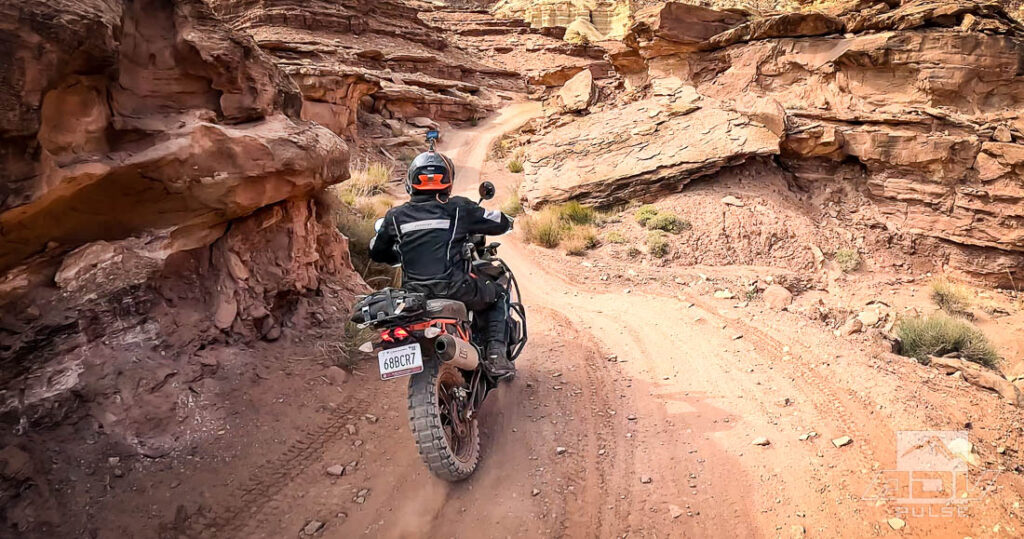

For adventure riders, the White Rim Trail offers the perfect blend of challenge and reward. The terrain is generally intermediate, with stretches of sand, rocky climbs, and ledges that demand attention but remain manageable for riders with off-road experience. The real payoff, however, is in the views. From the rim, you can gaze down into labyrinthine canyons carved by the Colorado and Green Rivers, or look up at towering red rock formations like Washer Woman Arch and Monster Tower. Each bend in the trail reveals a new vista, and it’s impossible not to stop often, shut off the bike, and simply take it all in. These pauses are part of the experience—moments to stretch your legs, hike to an overlook, or wander among the strange formations that make this landscape so unique.

The White Rim is also a place where time slows down. Unlike many rides where the goal is to cover ground quickly, here the journey itself is the destination. Riders often describe the loop as a full-day endeavor, though some choose to camp overnight at designated sites along the trail. Either way, it’s an immersive experience that demands preparation. Since 2015, the National Park Service has required day-use permits for all vehicles, motorcycles, and bicycles on the White Rim. These permits are limited in number and must be reserved in advance, ensuring that the trail retains its sense of solitude. Each motorcycle requires its own permit, and if you plan to camp, you’ll need an additional overnight backcountry permit. The system may add a layer of logistics, but it also protects the fragile desert environment and enhances the feeling of being in a truly wild place.


Along the loop, there are several points of interest that make the ride even more memorable. Musselman Arch, a natural rock span that seems impossibly delicate, is a favorite stop for photos and a short walk. The expansive views climbing over Murphy Hogback, one of the trail’s more technical sections, reward the effort with panoramas that stretch for miles. At the confluence overlook, you can peer down where the Green and Colorado Rivers meet, their waters carving deep channels through the desert. Each of these stops offers a chance to step away from the bike, stretch the legs and ponder the geology of the landscape more deeply.
Getting There
The White Rim Trail is most commonly accessed from Moab, Utah, a town synonymous with outdoor adventure. From Moab, riders can reach the trail via the entrance to Canyonlands National Park’s Island in the Sky district. The most popular starting point is the Shafer Trail, which descends a series of dramatic switchbacks from the mesa top down to the White Rim. Alternatively, the trail can be accessed from Mineral Bottom Road or Potash Road, depending on your chosen direction of travel. Regardless of where you begin, be sure to secure your day-use permit in advance through the National Park Service, and plan your fuel and water carefully. Once you drop into the White Rim, you’re committing to a full-day’s ride on one of the most iconic adventure riding loops—a journey that will leave you with memories etched as deeply as the canyons themselves.

Timing your ride is crucial. The desert climate can be unforgiving, with summer temperatures soaring well above 100 degrees. The best seasons to tackle the White Rim are spring and fall, when daytime highs are more moderate and the light casts dramatic shadows across the canyons. Early spring brings wildflowers, while autumn offers crisp air and fewer crowds. Winter can also be an option for those prepared for colder temps, though snow and ice occasionally make sections impassable. No matter the season, riders should carry plenty of water, food, and fuel, as there are no services along the trail.
For those looking to scratch this ride off their bucket list, we’ve chronicled the experience of riding the White Rim Trail in detail in a previous story—an invaluable resource for understanding the nuances of the loop for anyone doing it for the first time.
Photos by Rob Dabney

Author: Rob Dabney
Rob Dabney started a lifelong obsession with motorcycles at the age of 15 when he purchased his first bike – a 1982 Honda MB5. Through his 20’s and 30’s he competed in off-road desert races, including the Baja 250, 500 and 1000. Eventually, his proclivity for exploration led him to dual sport and adventure riding. Rob’s never-ending quest to discover what’s around the next bend has taken him on Adventures in Latin America, Africa, Europe, Asia, and throughout the American West. As a moto journalist, he enjoys inspiring others to seek adventure across horizons both near and far.Related Stories
Related Stories
 A Fiery Red‑Rock Maze With Sweeping Views Just Outside Las Vegas Nevada’s oldest state park sits less than an hour from the Las Vegas...
 ADV Destinations: Rattlesnake Canyon Desert‑to‑Mountain Corridor Rattlesnake Canyon is one of those rare backcountry trails that feels like a...
 ADV Destinations: The Abandoned Pumice Mines Of Red Rock Canyon The Mojave Desert is one of those places where history and geology often...
Popular Stories

Ducati’s Street‑Legal 450 Enduro Takes Shape Ahead Of 2026 Launch
Ducati’s push into off‑road competition is about ...

Yamaha’s Flagship Tenere 700 “World Raid” Is Coming To The US
Tenere fans rejoice! Yamaha is finally bringing...

British Couple Riding Through Iran Receives Harsh Prison Sentence
When Craig and Lindsay Foreman set off from Londo...

Putting Yamaha’s Revamped 2025 Tenere 700 To The Test
Yamaha’s Tenere 700 has been one of the most ...



Notify me of new posts via email
I hate it when one of my favorite trails is posted like this. There are already too many people using this loop. Last time I went on this a couple of years ago there was a waiting line to get up Murphy’s Hogback. Now I hear that there is a reservation system to use the trail.
If you are going to run the WRT approach it by going down Shafer Trail. Just make sure your brakes are in good condition !!