
Zero FX: Is The E-Dual Sport Experience Enough To Gain Converts?
A 289-pound dual sport with the torque of a liter-class ADV.
Zero Motorcycles has been around long enough now that it’s easy to forget just how early they were to the electric motorcycle game. They launched in 2006 back when lithium‑ion was still exotic and before Tesla rolled out their first production car — and somehow they’ve managed to stay alive through every EV boom-bust cycle since. Other electric startups have come and gone, but Zero just keeps quietly iterating and refining.
One of the models that has been around for quite some time evolving alongside the company is the FX electric dual sport. It debuted in 2013 and over the last 13 years it’s gotten more powerful, gained range, improved its tech, and even sharpened its looks. The core appeal hasn’t changed though: a sub-300 lb enduro with as much torque as a liter-class adventure bike, that requires barely any maintenance, costs cents to refill, and is quiet enough to ride through your neighbor’s backyard without them noticing.
It’s also a bike that I’ve been meaning to throw a leg over for years, not because I think it could replace my KTM 500 EXC-F but because I’m curious to know if these electric dual sports could earn a place in my garage in the future. So with that in mind, I set out to give our long-term loaner FX a proper test to see if it’s a dual sport I could live with, or at least get my head wrapped around where the e-motorcycle industry is headed and who this bike is built for.
What You Get
The FX may be one of Zero’s oldest models, but the latest iteration still feels like it’s incorporating some cutting e-bike tech. At its core is the air-cooled Z‑Force 75‑5 motor, good for 46 horsepower and a stout 78 ft-lbs of torque. It tops out at a self-limited 85 mph, but getting it up to that speed is where the real thrill lies.
Range is always the big question with electric dual sports, and Zero claims the FX’s 7.2 kWh battery is good for 102 miles in the city and 65 miles at 55 mph on the highway. That seems arguably decent for a typical daily commute and casual trail rides, but longer mixed‑terrain days would require some strategy.
What helps stretch those range numbers in the city, or on the trail for that matter, is the bike’s regenerative braking, which feeds energy back into the battery whenever you are coasting with throttle off or hit the brakes. Regen can be dialed up to buy you extra miles or down for your preferred feel.
Zero kept re-charging simple with a 650‑watt onboard charger that plugs into any household outlet. It takes about 9.7 hours to fully charge up from 0% with the standard option or you can use the accessory charger that drops the time to just over 4 hours.
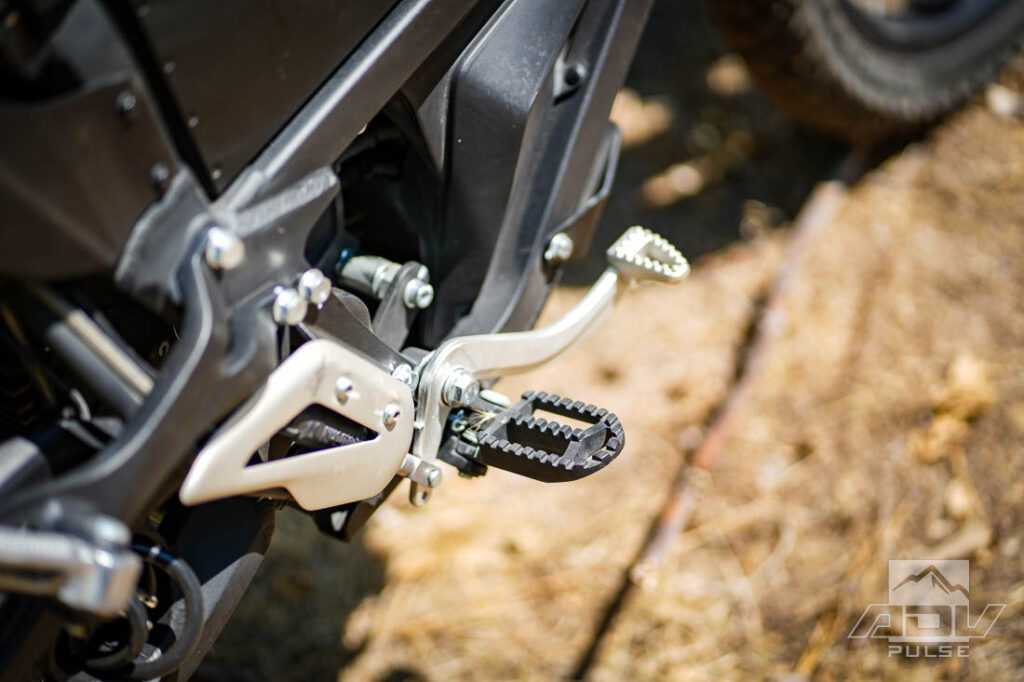
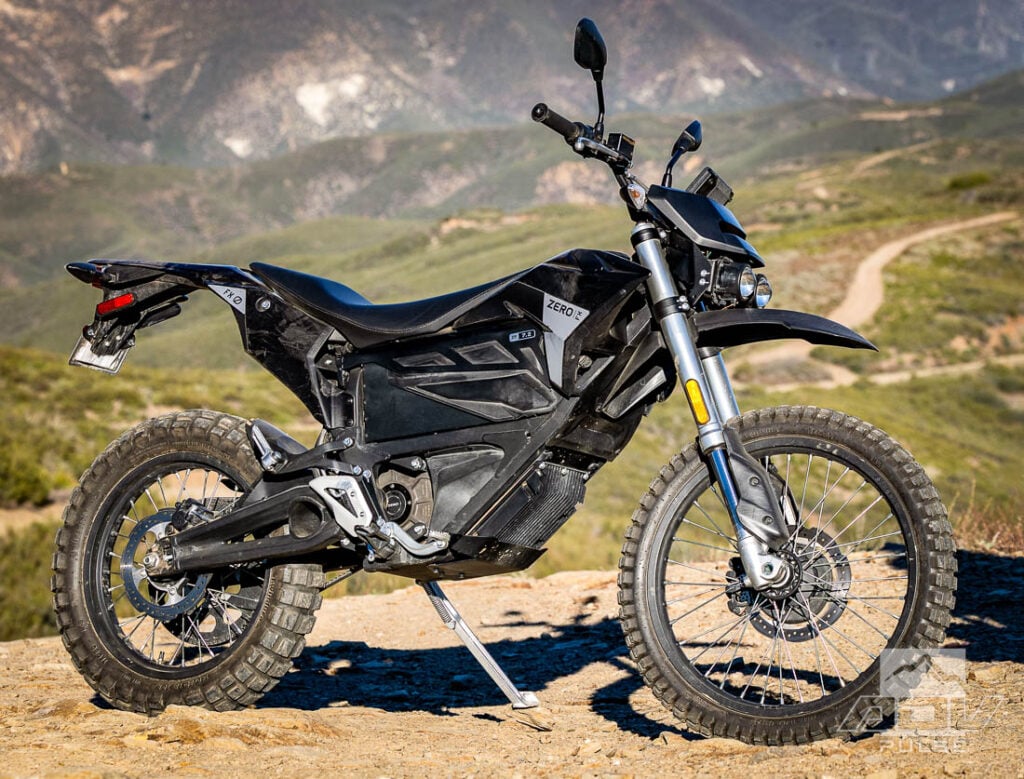
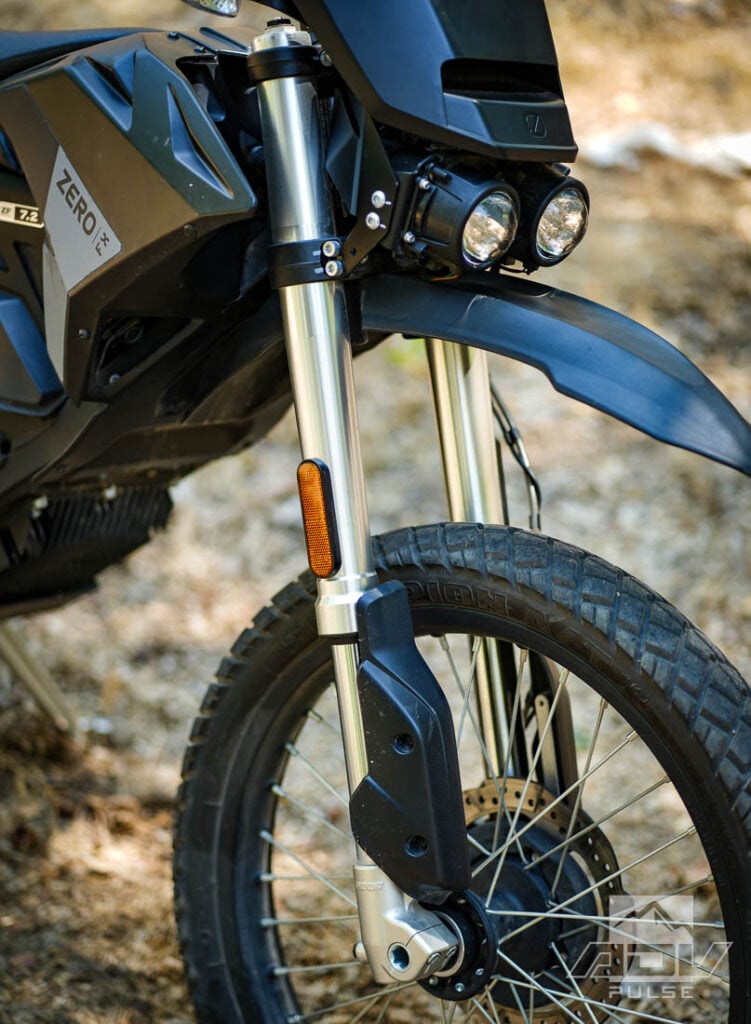
Where the FX gets more like a traditional dual sport is in its chassis. Helped by its aircraft-aluminum frame, it weighs 289 pounds, which is heavier than a performance dual sport like a KTM 500 EXC-F but significantly undercuts bikes like the Suzuki DR-Z4S or KTM 690 Enduro R. Other than a steepish rake at 25.4°, the geometry is classic enduro, incorporating a 21”/18” spoked wheel combo, 12 inches of ground clearance, and full-adjustable Showa suspension with roughly 9 inches of travel at both ends.
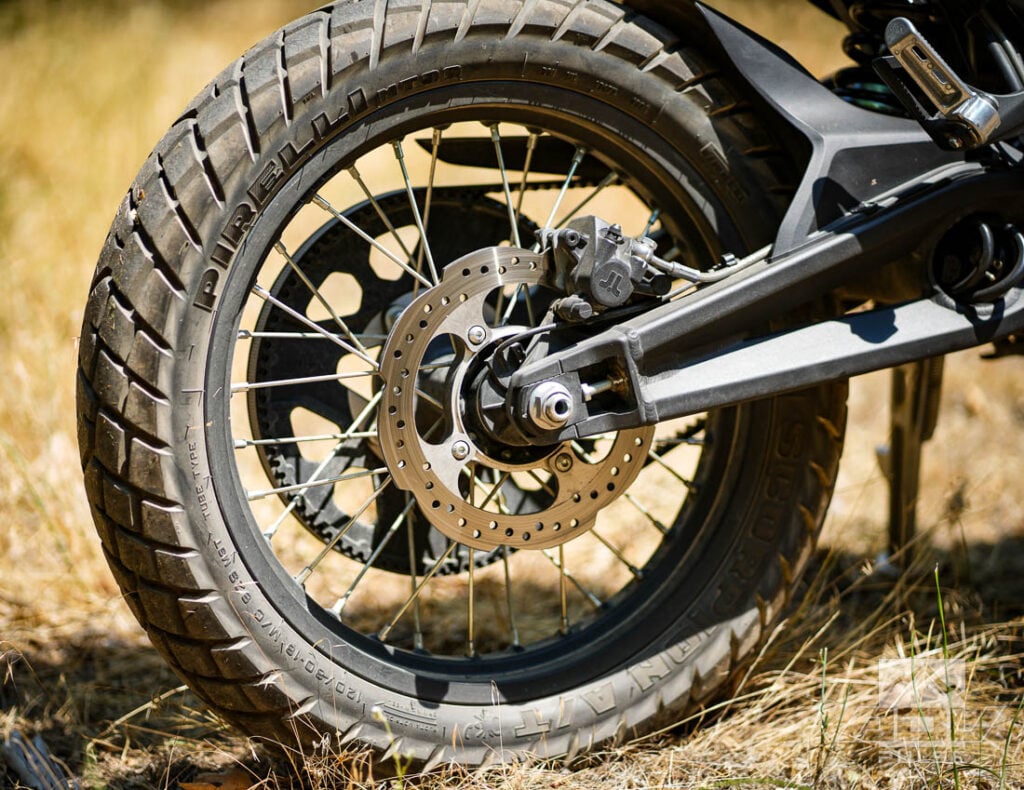
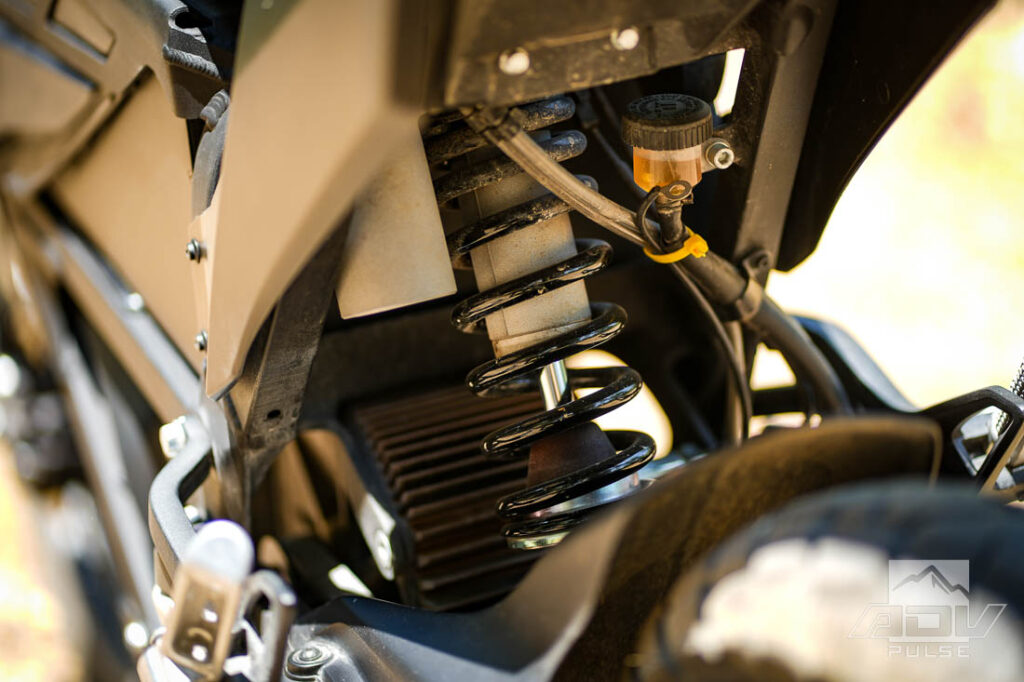
The seat height is also typical for an enduro at 34.7 inches, and a single 240mm disc up front, along with another 240mm disc in the rear provide the stopping power. The standard Pirelli MT‑90s lean more towards the street, but we ended up slapping on a set of Continental TKC80 50/50 dual sport tires for this test to get a better sense of the FX’s true capability off-road.
For the electronics, you get Eco and Sport ride modes out of the box and the Zero app lets you fine-tune things like the regen strength, throttle response and power output for the Custom ride mode. Bosch ABS is standard and can be switched off completely but other than that, there’s no traction control, no lean angle sensing, wheelie control, or any other advanced rider aids.
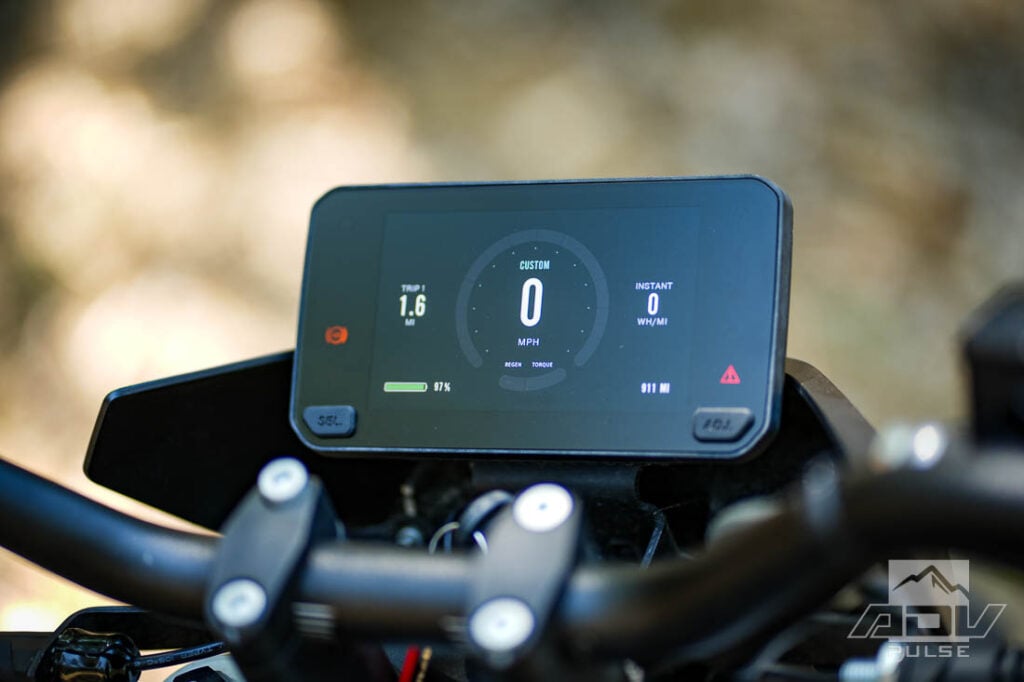
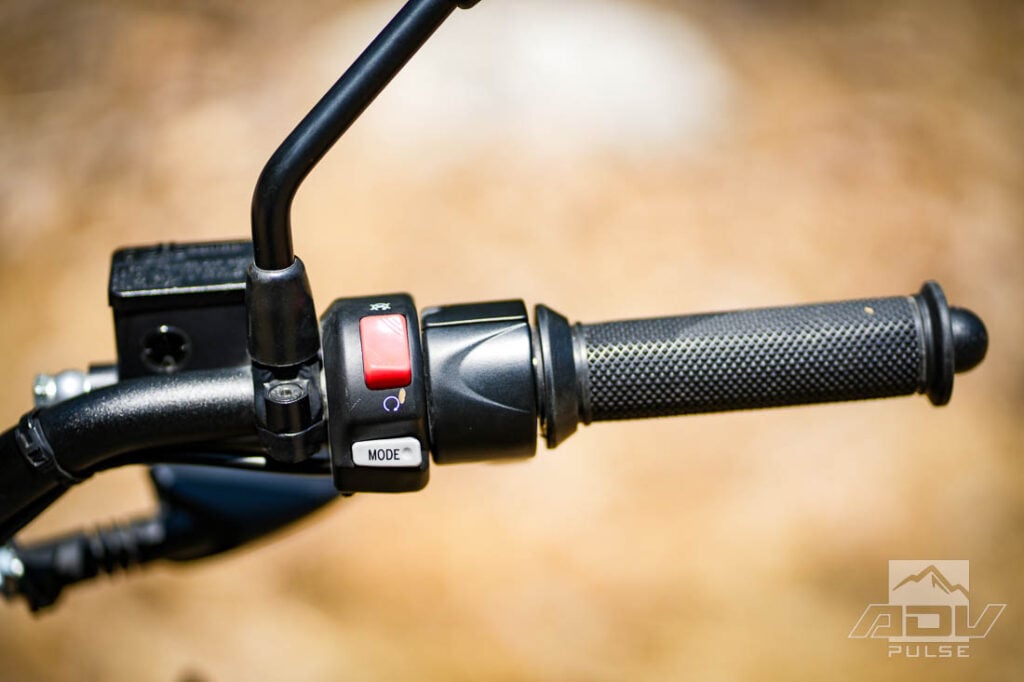
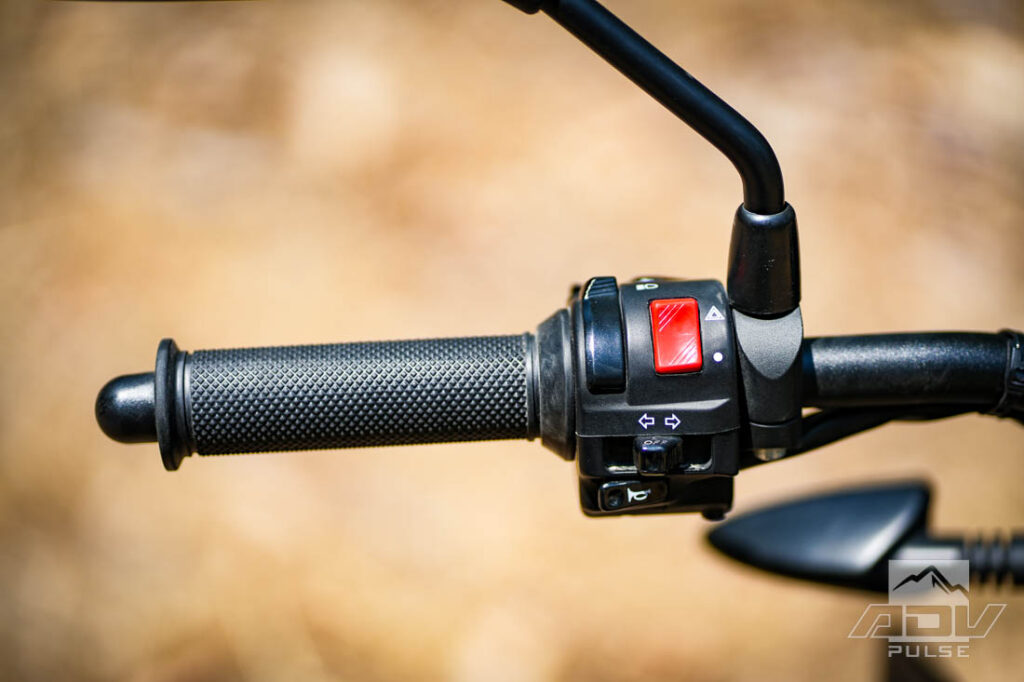
Modes are selected using the 5‑inch color TFT, which also provides essential information like speed, state of charge, power output, projected recharge time, regen rate, torque output, range, odometer, and more. Using the Zero app, you can select what critical information you’d like it to display as well.
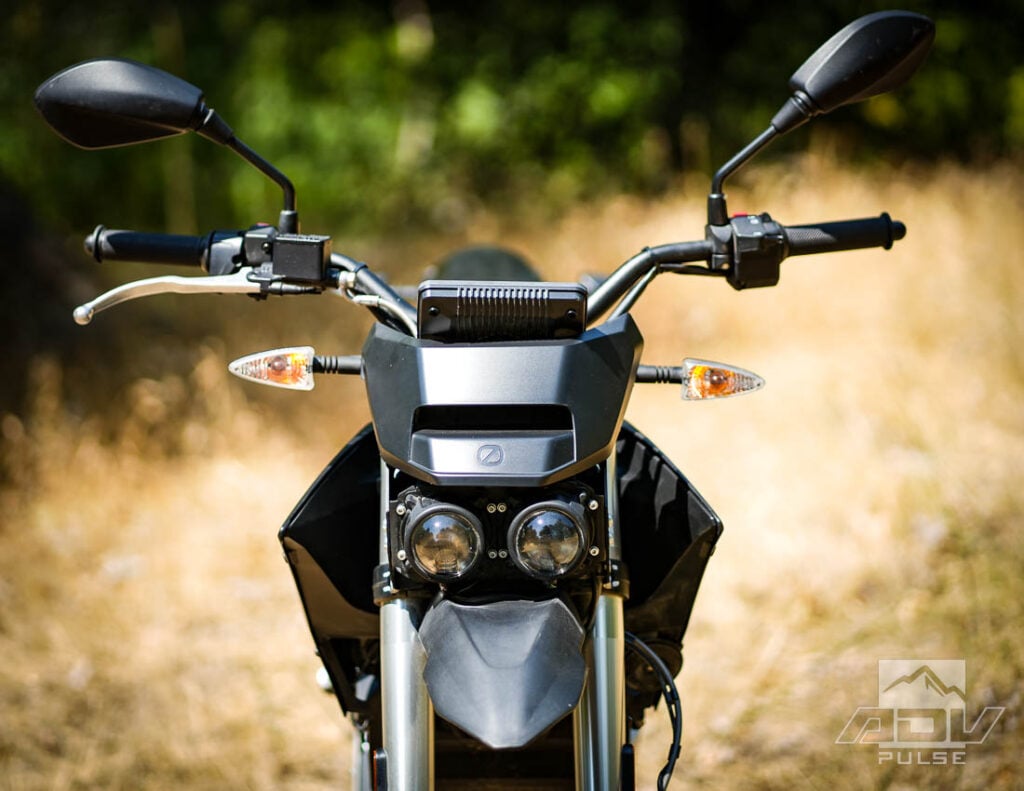
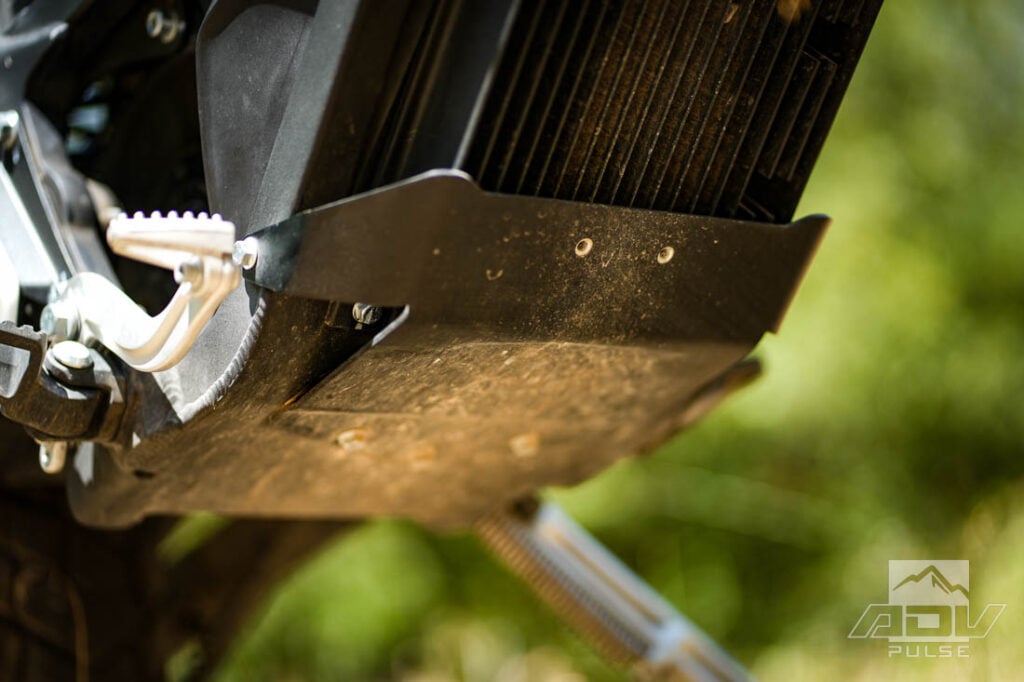
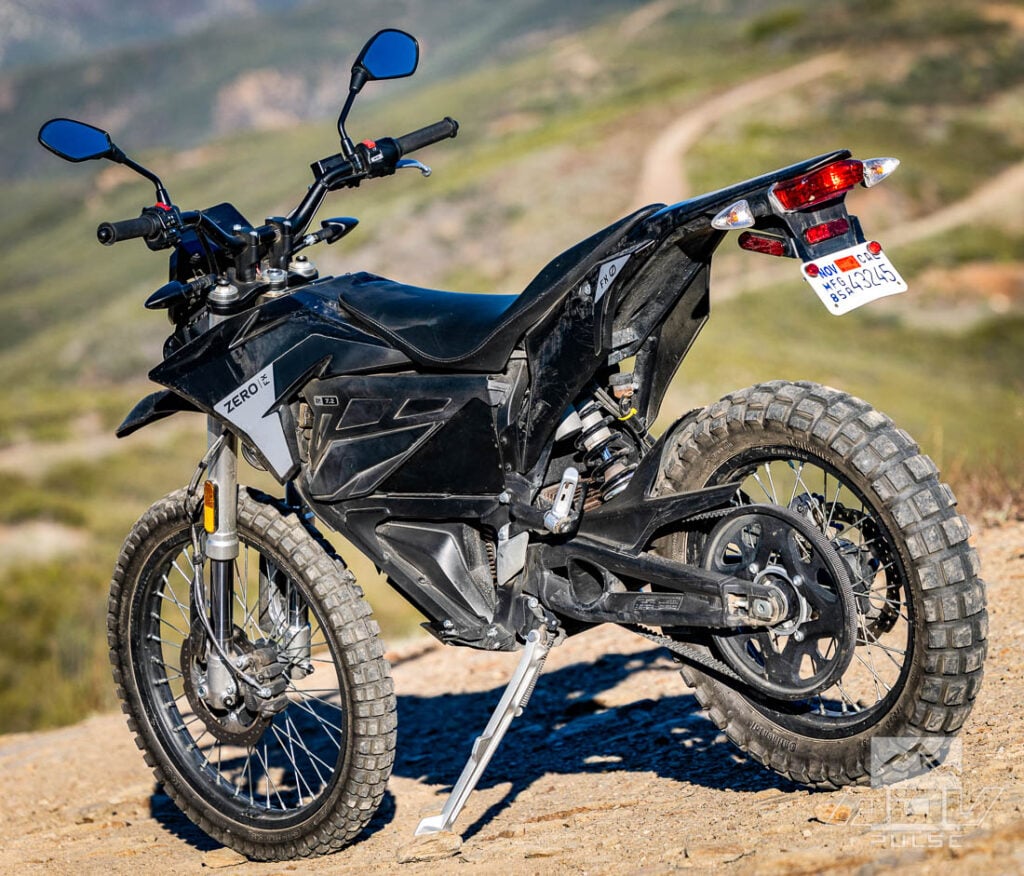
Getting the power to the ground, the FX uses a direct‑drive carbon belt that doesn’t need any type of lubing or replacing for 24,000 miles – just check belt tension periodically. The motor doesn’t have any scheduled maintenance, battery management is handled automatically in the background and other than that, you just need to change tires and brake pads when they wear out. The MSRP is $12,495 and the battery is backed by a five-year, unlimited mile warranty.
Getting Charged Up
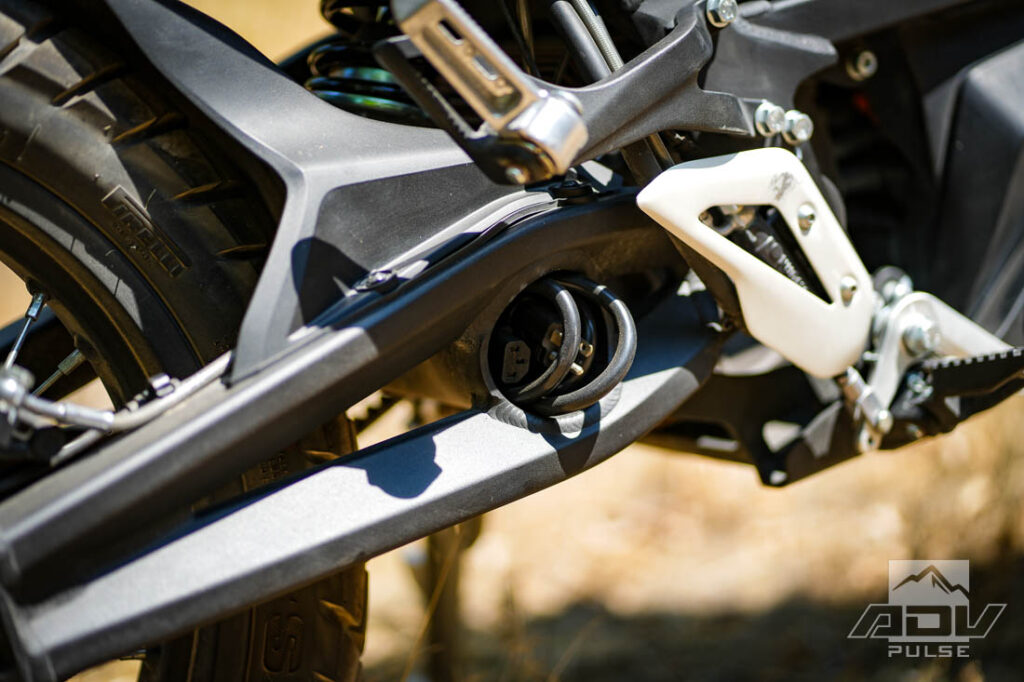
The bike came with a charging cable that plugs into any standard 120V home socket. The swingarm also has an opening in it that is designed to house the cable, and I was told it will stay in there securely while riding. Although about halfway through my first off-road ride, it went missing on the trail. So I wouldn’t trust the cable storage option unless you are riding it on the street. Luckily, it’s the same generic charging cable that plugs into the back of your printer, so I had another one lying around the house.
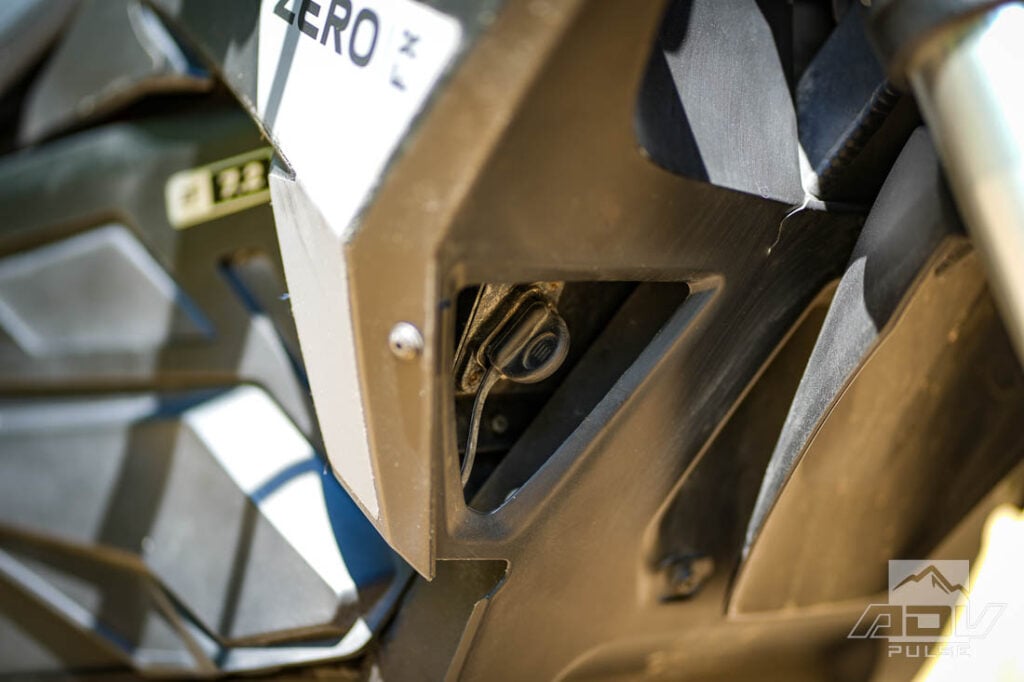
Before heading out on a dual sport ride, I looked into using public charging stations as an option to get a quick re-charge during a lunch stop but most of these use a special J1772 plug that is not compatible with the FX. Zero sells an adapter that lets you charge with this style plug but it won’t increase the charging speed compared to plugging into a home electrical outlet. There are some public charging stations that offer standard 120V charging outlets but in my research I found these are often inoperable once you get there.
For a quick top-off, you might be better off calling ahead to a restaurant to see if they will let you plug in while you eat. With no on-the-go fast charge options, the FX is really built more for day trips than travel. Typically your garage becomes your gas station, otherwise, you’ll need to do some planning ahead. For overnighters, you can check with your hotel to see if they have charging options for EVs or if you Van-Camp in a riding area, you could bring a portable power station. For those planning on using the FX for longer trips, you’ll definitely want to get the J-plug adapter to increase your charge-up options.
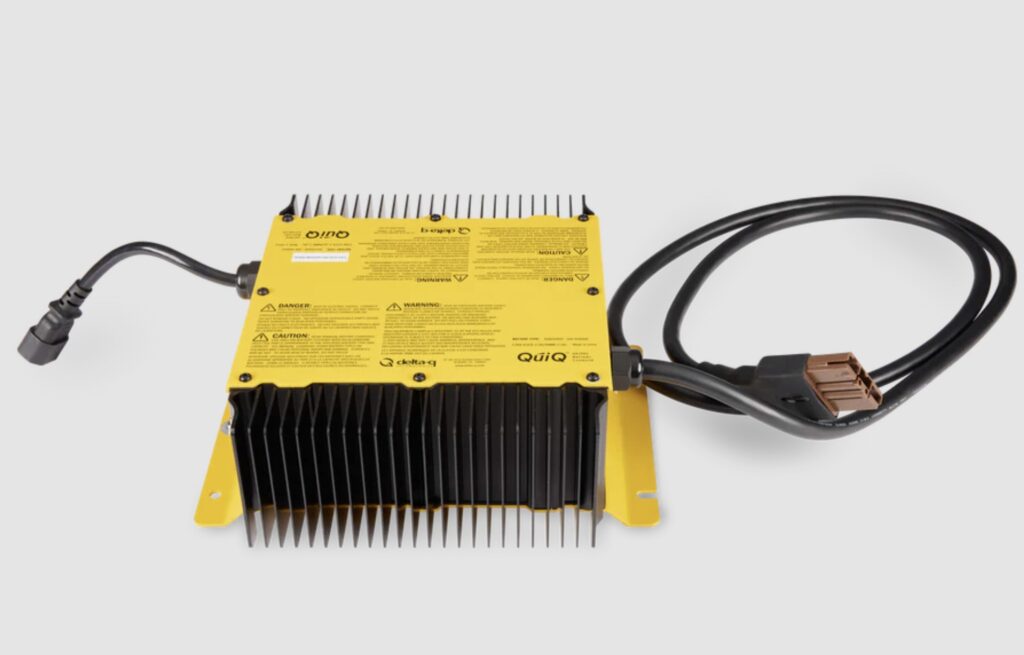
I did get a chance to test out the accessory fast charger, which uses a separate plug-in port hidden under a rubber flap, but this is a toaster-sized box that’s set up for garage use. Or perhaps you could bring it to work if you have a long commute and get a full charge in the claimed 4 hours rather than waiting 9 hours with a standard outlet. When I tested the fast charger, initially it said it was going to take 7 hours and 50 minutes to complete a 0-100% charge. However, that initial estimate was not accurate and it did end up re-adjusting the time as it warmed up, eventually taking around 6 hours to complete.
If the bike is sitting in the garage for a month or so, it is recommended you keep it plugged in during that time and the on-board charger will automatically maintain the battery, even in extreme winter weather down to -31°F (-35°C). For longer durations, there is a “Long Term Storage Mode” setting you can enable in the Zero app that will optimize battery life when stored for many months at a time.
On The Street
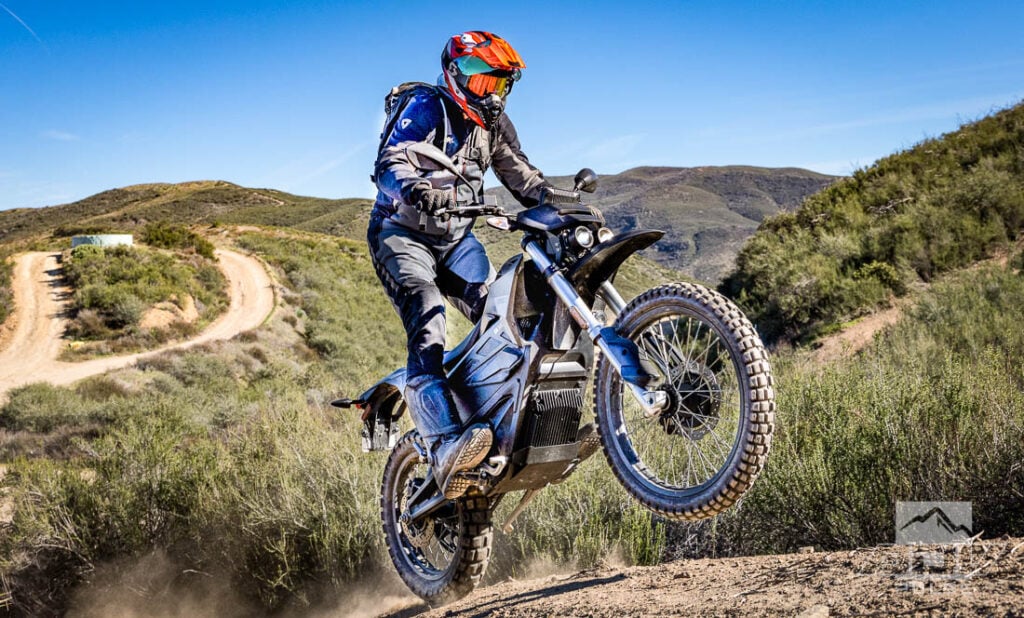
With 78 ft-lbs of torque instantly on tap in a sub-300-pound machine, the FX accelerates rapidly. There’s no clutch, no gearbox, and no buildup of power, just a smooth, immediate rush of speed. With the dash set on Sport Mode, it hits hard like a 450cc motocrosser. If you are used to the way gas engines increase power progressively as the RPMs rise, it can take some getting used to. Rolling power wheelies are effortless and It feels like it wants to loop you off the back at slower speeds.
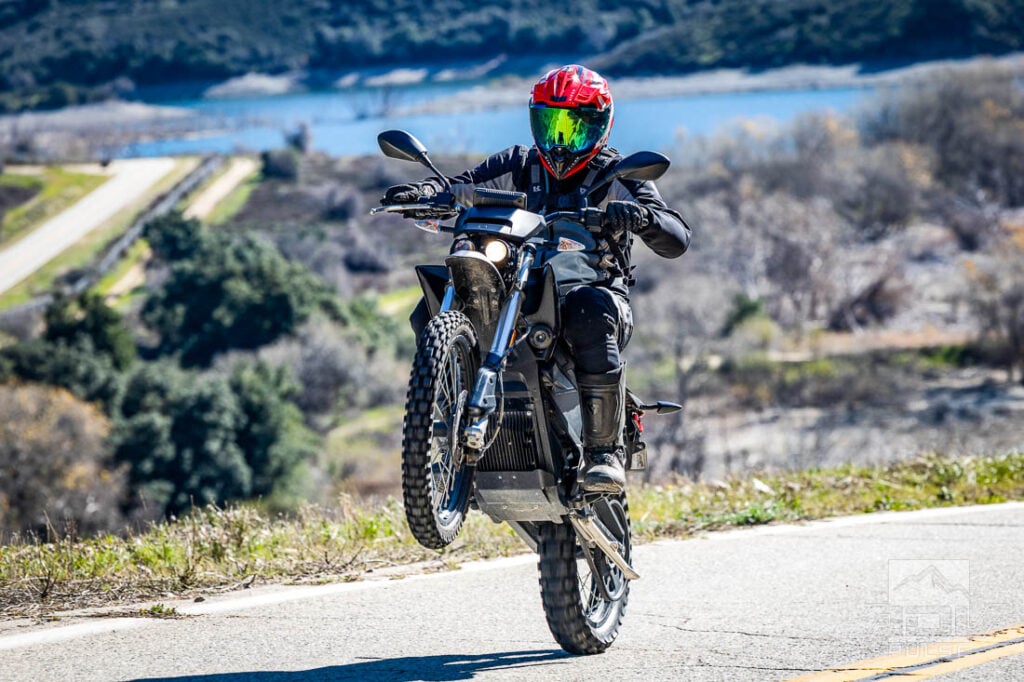
I primarily kept it in Eco Mode because it saved range and it still had good power that was more manageable — perfectly adequate for tooling around town. Its smooth, quiet operation and nimble slow-speed handling make it a great bike for navigating street lights and heavy traffic. Lane splitting is easy going with its narrow enduro layout, there’s no clutch or gears to fool with and you get instantaneous power once the light turns green. The one drawback is that nobody is moving out of your way like they would if you had pipes rumbling. Sometimes I did feel like the bike was less noticeable to traffic or people mistook the FX for an e-bicycle. For example, they’d attempt to pass me if I wasn’t all the way in the middle of the lane and not going as fast as they’d like.
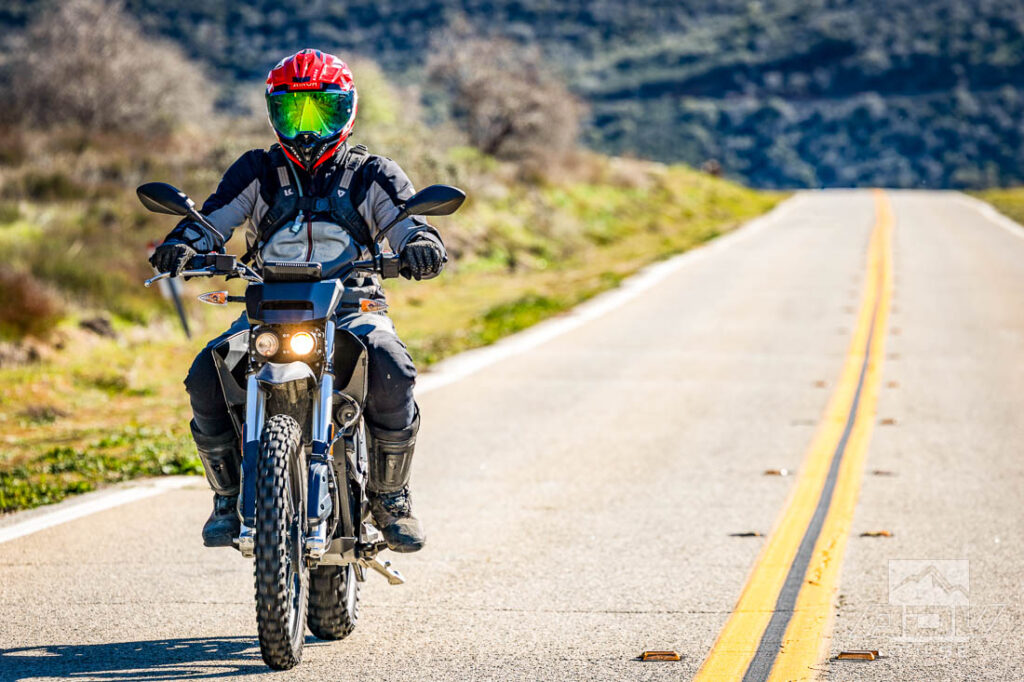
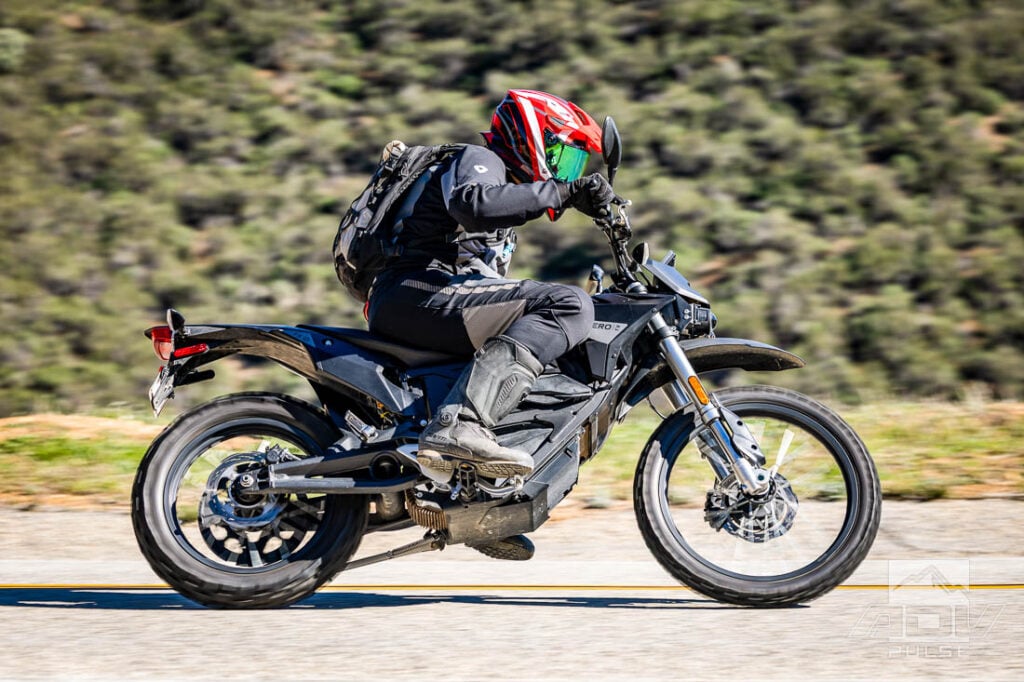
Jumping on the freeway for short stints, it has no problem keeping up with traffic. It remains stable and smooth and the seat is comfortable. The handlebar placement feels dialed and the seat has good cushioning. The saddle slopes down from the front, then rises with a mild step at the back. At 6’2” tall, the seat feels low to me and the knee bend is a bit cramped. It never got uncomfortable but if this bike had the range for long freeway runs, it might. It also has no windscreen so you are getting blasted with air in the chest. Range suffers at a constant speed more than any other place, so it’s best to get somewhere interesting to ride within 10 miles or so on the highway or you won’t have much range left to enjoy it once you get there. Needless to say, this isn’t much of a highway bike. Nor are most single-cylinder dual sports.
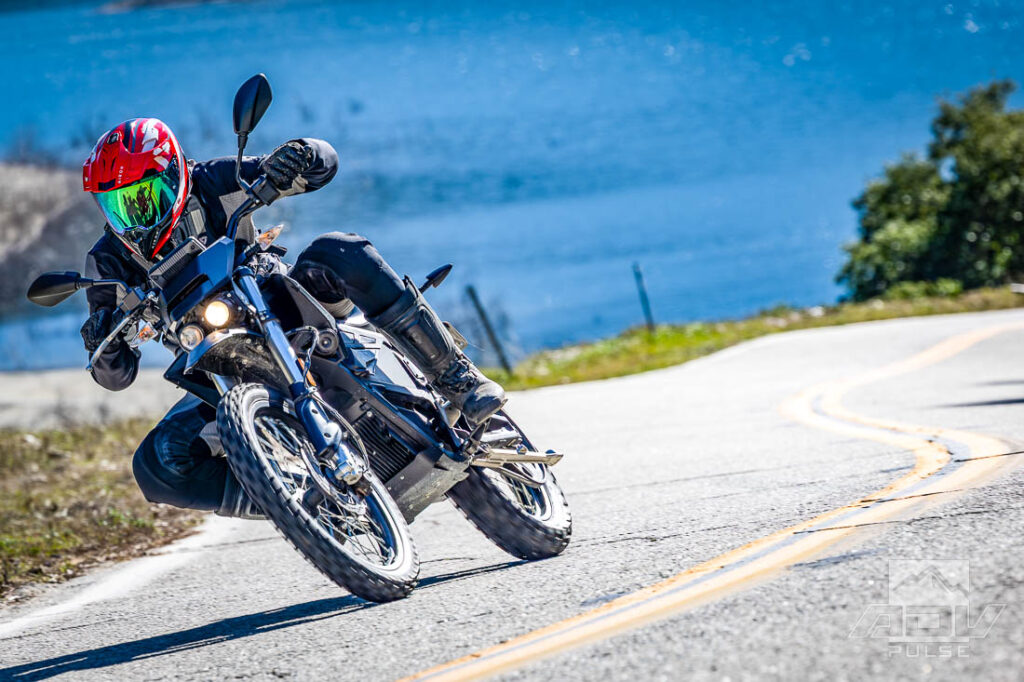
Twisty asphalt is definitely on the menu though for the FX and it feels much like a lightweight Supermoto bike with good maneuverability and handling. The bulk of the battery’s mass is carried down low so it feels lighter than its spec sheet might imply. Performance from the J-Juan dual-piston floating caliper on the 240mm single disc is responsive but they aren’t stop-on-a-dime sport bike brakes. It’s a fun bike to ride like a hooligan except for one caveat, the kickstand scrapes prematurely when you lean it deep into left turns. You can corner hard on right handers with no touch downs but the left side is limited on lean angle for those who like to rail hard. There’s good grip from the stock MT90 rubber in the twisties, as well as the TKC80s, but you still have to be careful in Sport Mode not to smoke the tire coming out of a tight turn with no traction control and all that torque.
On The Trail
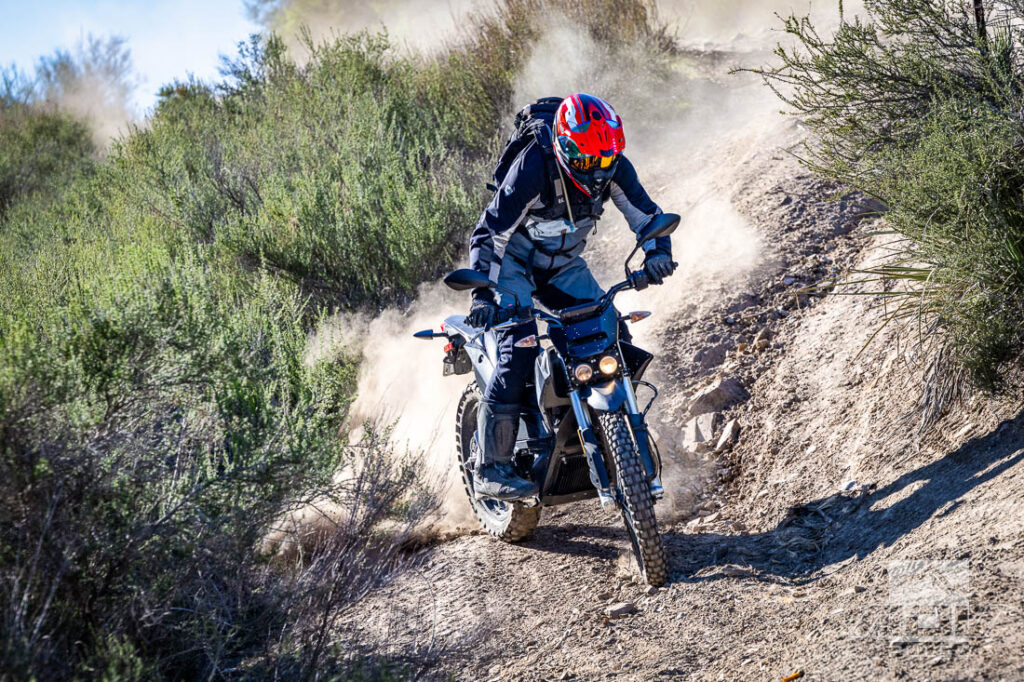
For my first ride in the dirt on the FX, I just wanted to get a feel for the power delivery and usable range. With the standard MT90 tires, I wasn’t expecting to do much technical terrain either but I quickly realized how limiting the tires are when you’ve got this much torque on a skinny 120mm wide 80/20 (street/dirt) rear tire. The tire spin can easily surprise you because on a gas bike, the engine gets a lot louder as the tire begins to slip. On an electric bike, any engine whir is overpowered by wind noise — suddenly the rear tire just starts floating around.
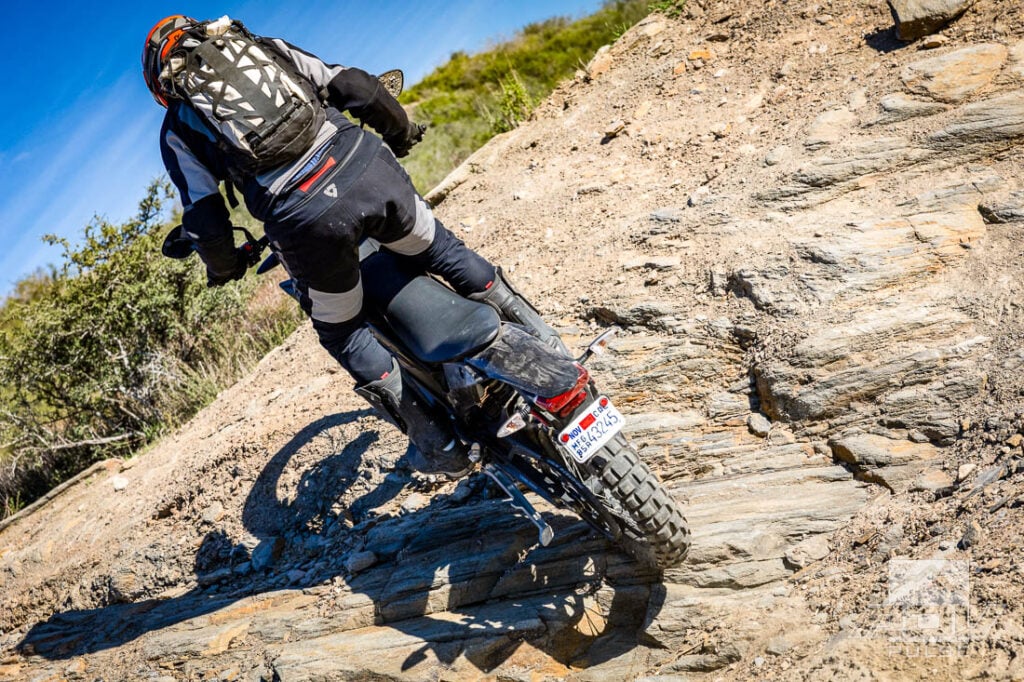
Riding in Eco mode was definitely a must for woods-style terrain with the smooth tires. The power comes on softly and it has more of a 250cc four-stroke feel in terms of power output. At slower speeds, it easily walks over rocky step ups, without any need to feather the clutch or compensate for the increased load with extra throttle. There’s no hesitation, it just rolls over things that might kill the momentum of a gas engine and cause a stall. For new off-road riders, I could see how this would be a huge bonus.
As mentioned, ergos are a little cramped in the sit down position. I’d prefer having a taller, flatter seat that you can scoot your weight back on without encountering the hump. For an enduro style bike, that seems like a miss on Zero’s part not giving it a flat seat that lets you shift your weight all the way back or forward — especially considering there’s no fuel tank to get in the way. It does let you slide your weight forward on the tank but it’s more of an uphill angle. I can’t complain about the comfort of the seat though. If you’re just looking to tool around on dirt roads all day, it’s a cushy saddle to spend some time on.
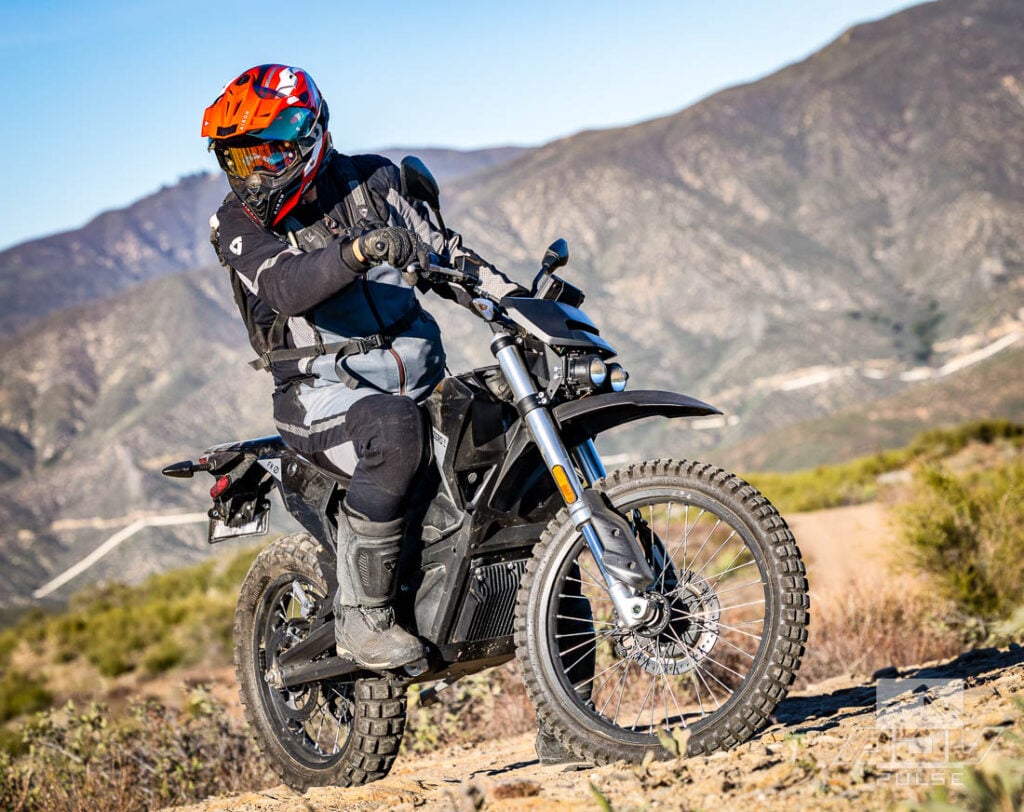
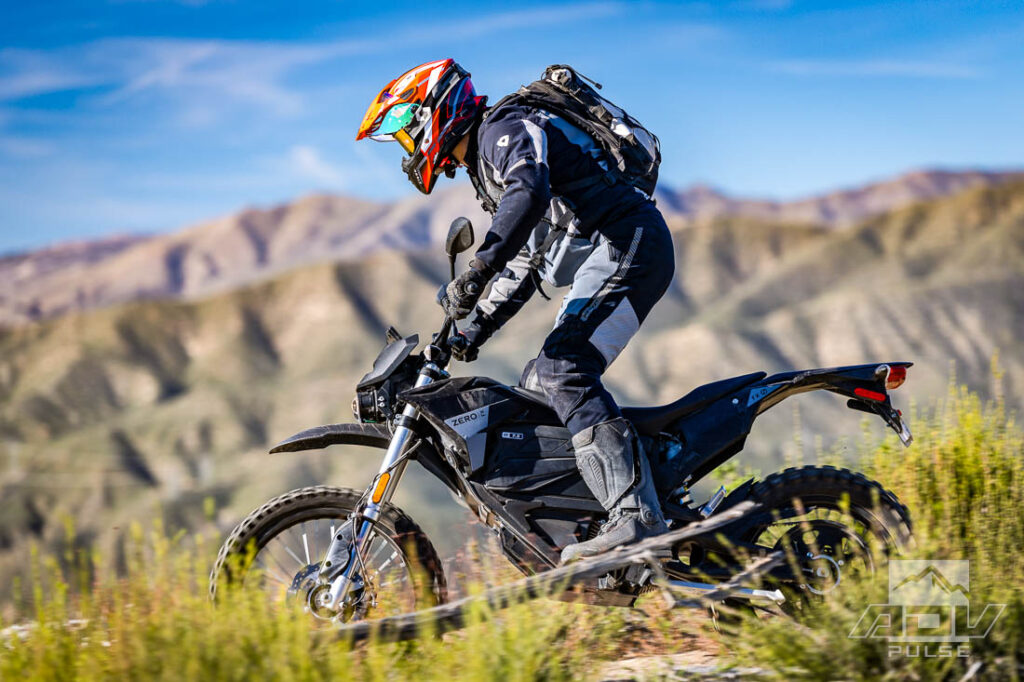
Standing up it feels like a proper enduro machine but the distance between the bars and the pegs feels a little tighter for a taller rider like myself. You’re a bit too upright and it’s hard to get down in the attack position. A set of bar risers that move the bars forward would be ideal. It’s a slender bike, so you can squeeze it with your legs and the wide platform-style pegs offer good support. It’s also easy to turn around on a tight trail.
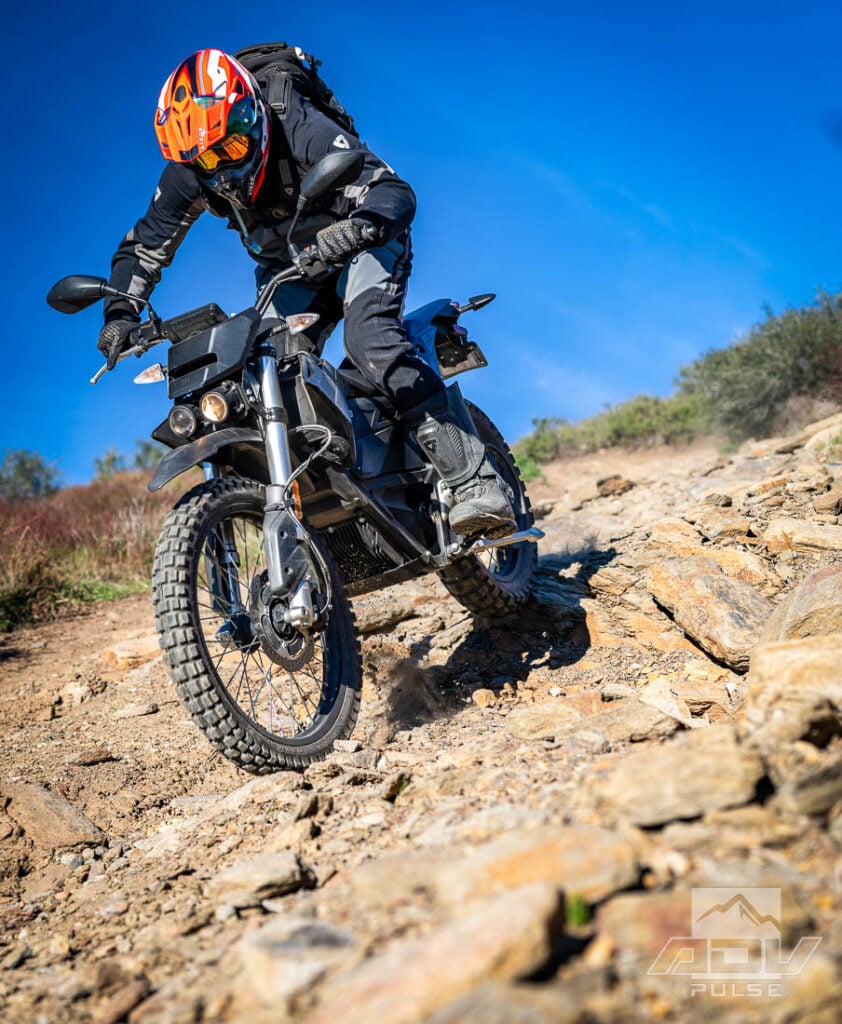
The handling is good and it feels almost like you are riding a mountain bike at times, perhaps because of the shortish 56.6” wheelbase that gives it quick slow-speed maneuverability and how quiet it is. It’s a totally different experience I think everyone should give a try: ripping down a single track trail in a forest on an electric bike. While stealthfully traveling through the forest, I surprised more than a few deer and scared the hell out of a few dog walkers. A benefit to safety is you can often hear those loud UTVs coming toward you on blind turns, before seeing.
The ABS system works ok for basic trail riding but the system does feel tuned heavily towards the street. On a few occasions when I forgot to turn it off on steep terrain, I found myself freewheeling towards obstacles as the system got overwhelmed. Turning ABS off is not as straightforward as I’d like though. The sequence involves turning the kill switch off, then holding the Mode and Adjust buttons for 4 seconds with the kickstand down. Forget to do any of those four things and it won’t work.
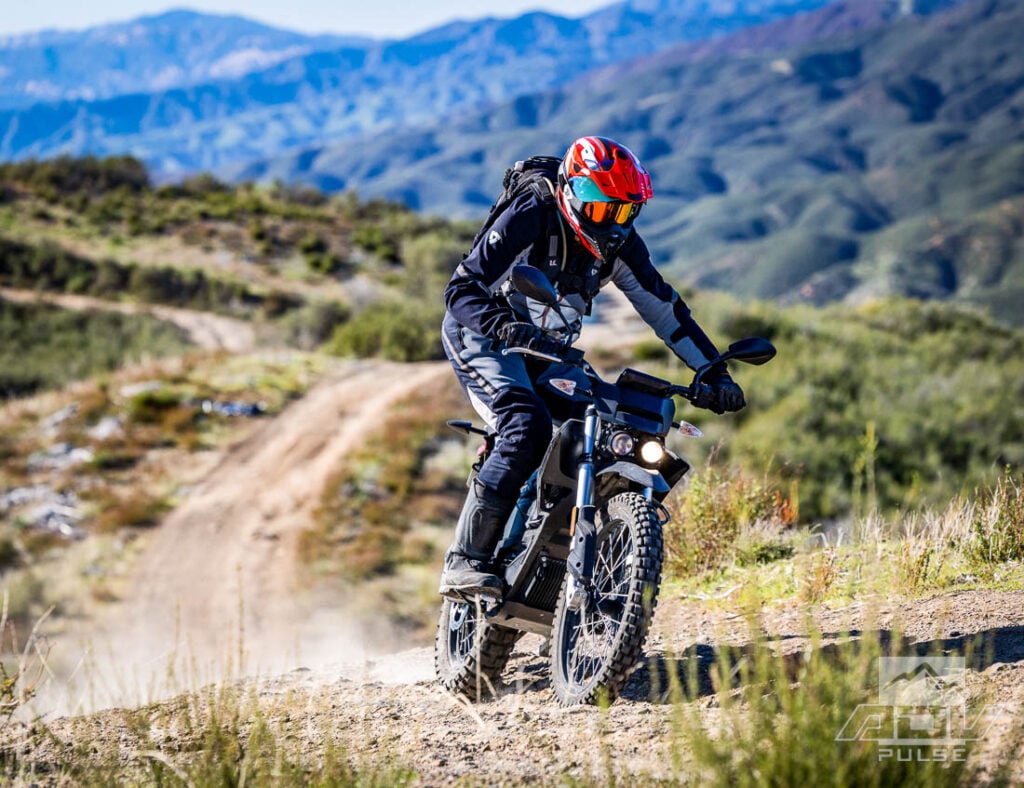
As far as the suspension, the 41mm fork felt a little flexy when pushed hard but it has decent hold up with only the occasional clunk. It felt plush over everything up to fist sized rocks and handled big g-outs well. I dialed in the rebound and compression damping with the adjusters and it felt much more lively but it’s still a little soft for an aggressive off-road rider. Big hits at speed or flat landing jumps compress the suspension enough to bottom out both the front and rear with a rider of my size at 210 pounds.
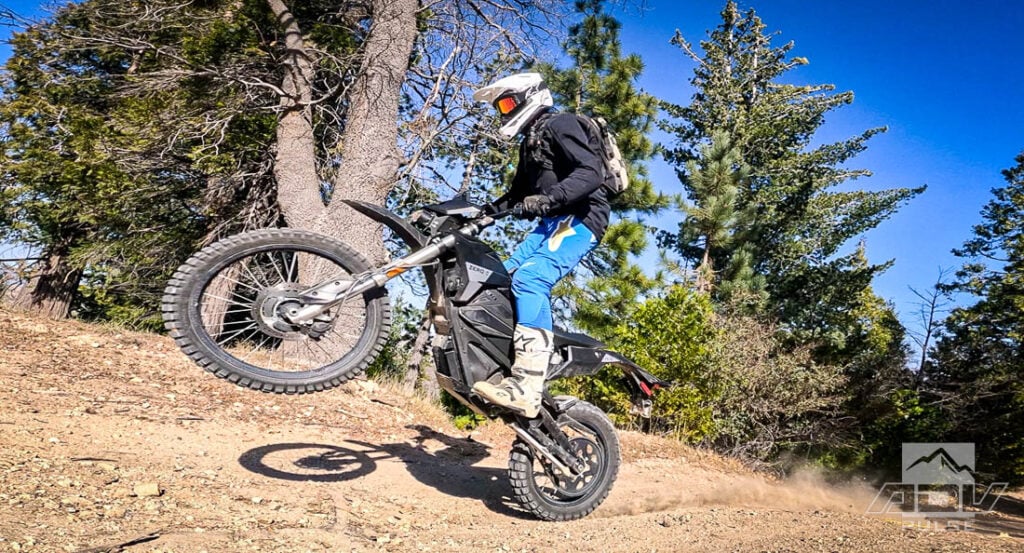
The rear shock needs help the most with stiffer springs, and more travel would be appreciated. Ground clearance is pretty good though at 12 inches, which puts it in the range of bikes like the DR-Z4S or CRF450RL. On rocky step ups, I rarely ever felt it touch down or scrape. It’s not a bike built for hammering though. It definitely falls in the casual dual sport category more than a pure-performance model (more Kawasaki KLX300S than KTM 500 EXC-F).
Having made it through a day of riding on the stock tires, I knew I had to spoon on some more-aggressive rubber to better explore the bike’s potential. A set of Continental TKC80s seemed like a good match for the bike’s personality. Straight away it made a noticeable difference. While the TKCs are by no means a chunky knobby tire, they were enough to take this fairly light and nimble machine into some technical sections and cut down the excessive wheelspin.
For the next ride, I decided to configure the Custom Mode with all the power settings turned down and the Regen settings turned up to conserve range and reduce tire spin. Riding in the Silverwood Lake, California area, I hit the ridgeline trail called 2N17X that ascends some 1,500 feet in elevation in just 5 miles. Along the way there are several steep, loose climbs. On the first one, I tried Sport Mode to see how it would behave with the new rubber. I ended up not making it due to tire spin when I took a rather sandy line that was a bit much for the TKCs to handle. On the second pass, I went back into the low-power mode and pointed it towards a rockier line. With the throttle opened wide it slowly tractored its way up the trail in a casual manner with good control, virtually no wheelies or tire spin, and no worries about stalling.
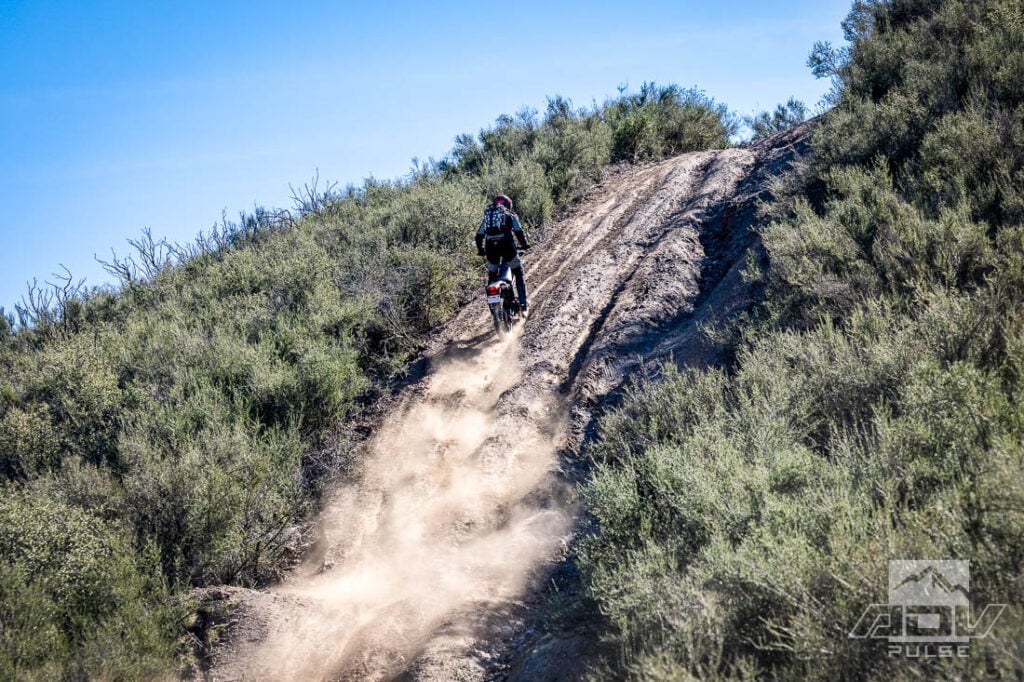
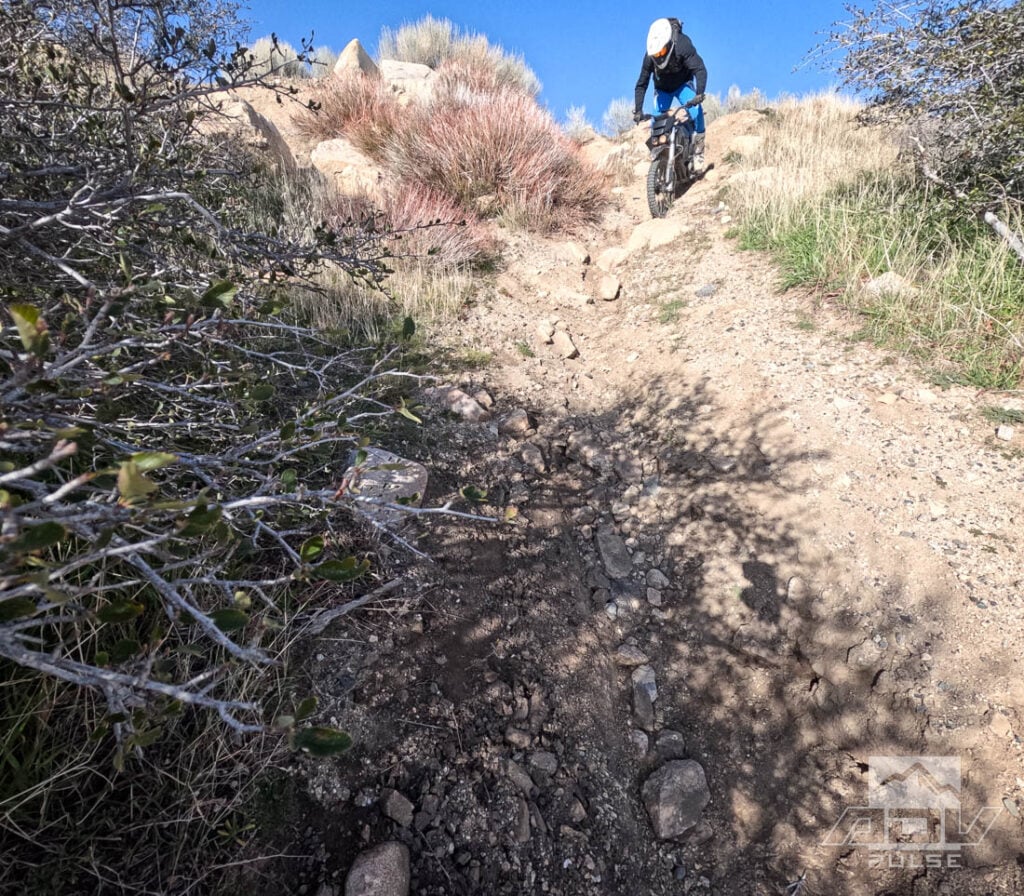
The final hill climb at the top of the mountain is the big challenge though. With nasty ruts and rocks at the bottom, and a sizable step up mid-hill that you need to clear with significant momentum, it’s a challenge for even a solid off-road rider. On a performance dual sport with real knobbies, 30 pounds less weight and 3 inches more suspension travel, this hillclimb still might take you a try or two.
The first attempt, I tried it in the low-power mode and immediately I realized the suspension was getting overwhelmed as I tried to hit the bottom of the hill with as much speed as possible. I didn’t get the momentum I needed and stopped just before the step up. On the second attempt, I put it back in Sport Mode to see if more power would help but it was too squirely and this time I stopped even further down the hill.
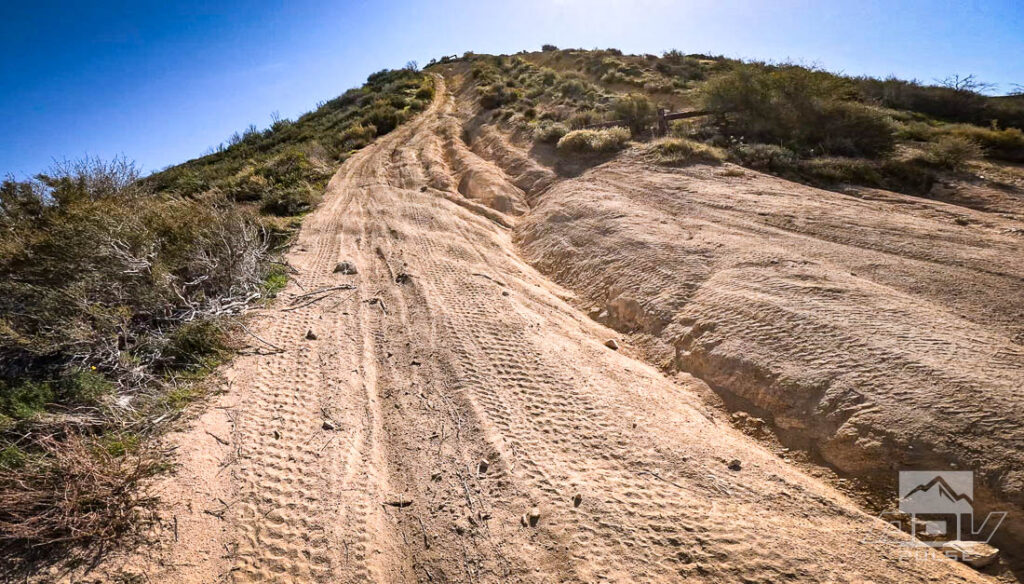
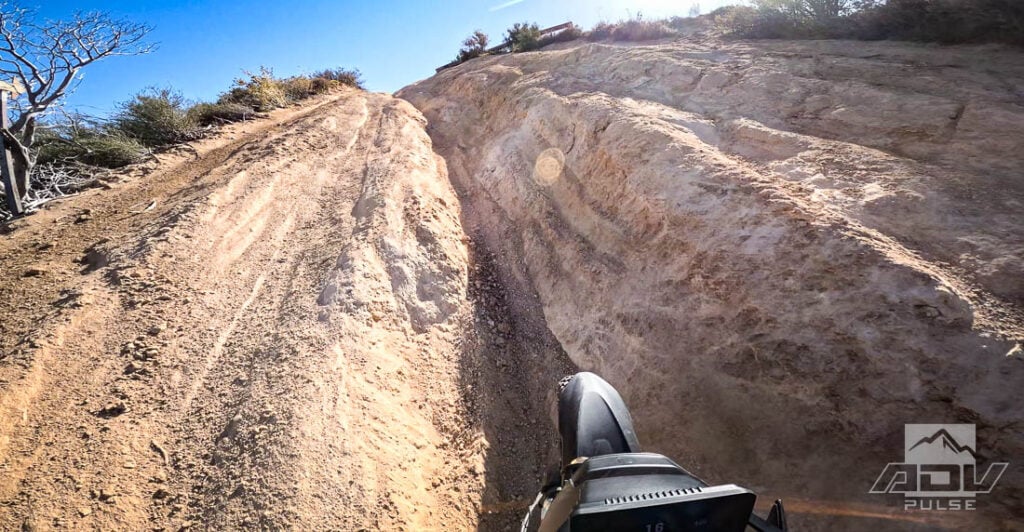
Before my third attempt, I considered heading back down the hill in defeat, something I’d never had to do before. I figured I’d give it one more try with a different line though. The right side looked just as nasty with some even bigger ruts but didn’t have as big of a step up. Putting it back in the low-power Custom Mode, I got some decent speed and rode through the deep ruts kicking up loose rocks and feeling the front wheel slowly come up, though in a calm manner. Everything was in slow motion compared to my previous climbs but the FX managed to claw its way inch-by-inch to the top. It wasn’t flashy but I got through it. To be fair, doing this hill climb on something like a KLX300S or CRF300L would be a similar challenge to get to the top.
While that was probably the sketchiest section of trail, there were several other challenging tracks I encountered in the Lake Arrowhead OHV area that day, as well as some sweet single track that was a blast to ride the Zero on. Even in the low power mode, you can still pop wheelies and launch off risers because the torque is always there – no need to be in the powerband. The brakes were adequate for steep descents (with ABS deactivated) and didn’t feel grabby or overly sensitive either. However, they’re not the most powerful brakes.
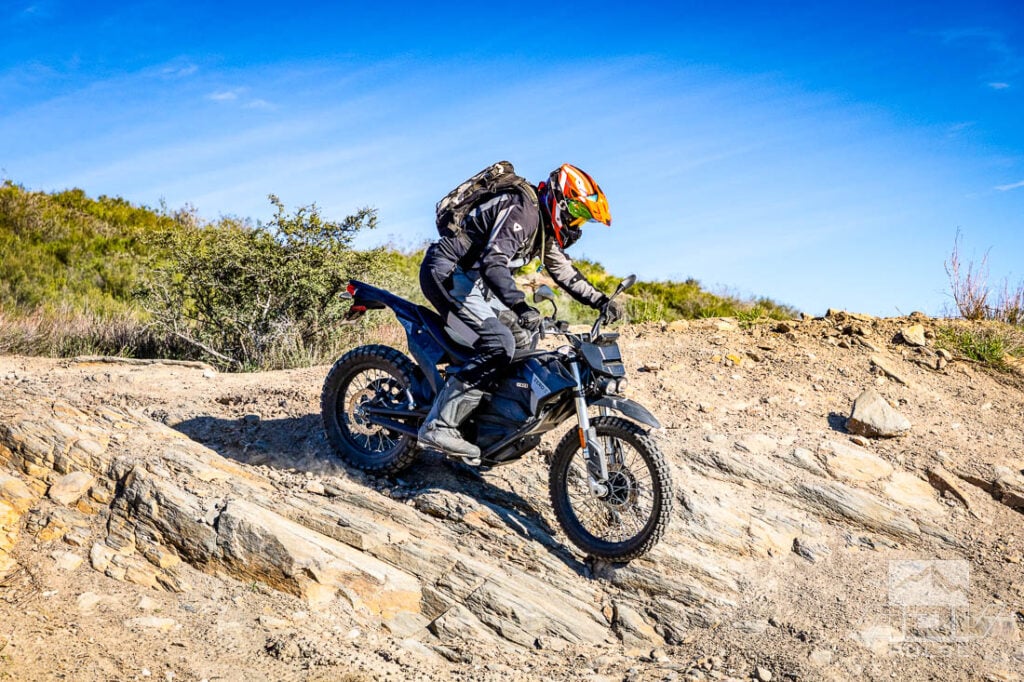
While I never felt limited to where I could go, the more-casual dual sport design of the FX required some extra skill and effort to venture into highly-technical terrain. The one downer in the ride experience that reared its head again was the low kickstand that seemed to scrape in every rut. And of course I did have some range anxiety to deal with, the farther away I got from my truck.
The Range
Looking at the manufacturer’s claimed city range estimate of 107 miles, I was hopeful that I could achieve something close to that in off-road miles. Essentially, it’s a similar type of riding with stopping and going, except minus the hills and spinning tires in loose terrain. I figured if it was rated for 57 miles at 70 mph, I could possibly get something in the 80 mile range? That would be more than a full day of technical off-road riding with a cushion of range in case a wrong turn was made.
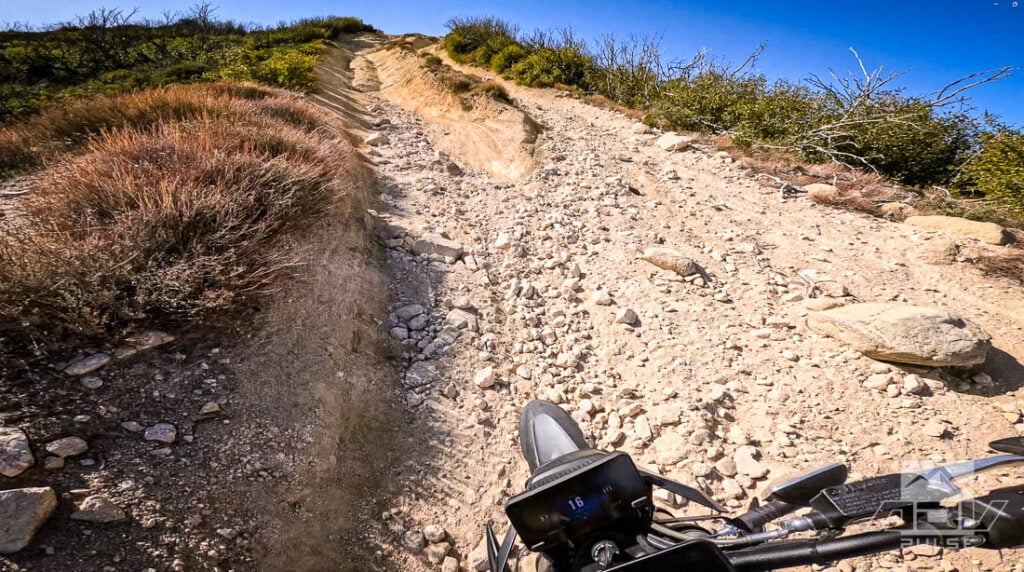
On my first ride on the stock tires, sticking to mostly fire roads and mixing in some road and a few single tracks, keeping it mostly Eco Mode I managed to achieve 60 miles. On that ride, it hit 0% at about 55 miles. I continued riding near my truck to see if I could eke out a few more miles and I made it to 60 miles without it ever dying, which indicated there’s a good safety buffer there. On my second ride, riding on the TKC80s, we were doing a lot of photo passes at full-throttle in Sport Mode, including 20 miles on the highway. I got to about 40 miles on that ride and again, it showed 0% for about 5 miles and never died before getting to the truck.
The final ride in mostly technical terrain didn’t go as well as I planned. Even with the power turned down in the Custom Mode much of the day, I was already seeing 30% battery life just 30 miles in. However, this was after a significant elevation gain and I knew I’d be descending some 2,000 feet heading back.
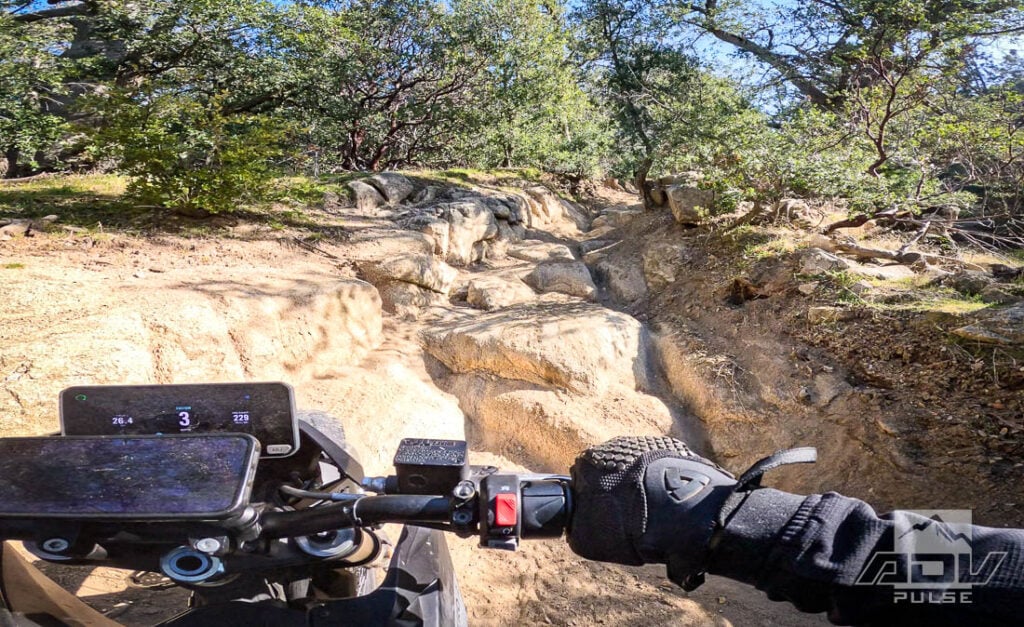
The Regen did its job heading back down the hill as I could see the battery percentage tick up a few points. Eventually though as things flattened out, I was at 0% and still about 6 or 7 miles from the truck. Confident in that buffer I’d experienced on earlier rides, I continued to give it the gas, even passing dirt bikers on the trail heading back to the staging area. On the very last hill my optimism bit me. Just one mile away from my truck, it went completely dead, so I had to do some pushing about 100 yards uphill before I could coast the rest of the way. After a solid day of aggressive trail riding, with a lot of elevation gain, I was able to achieve 46 miles of range.
The Bottom Line
Whether you are charging trails or traffic lights, there’s no denying the thrilling acceleration of the Zero FX is a big part of its appeal. When you’re not riding it like a hooligan, it lets you stealthfully explore deep into new riding areas. The electric experience is something I’ve come to find unique and enjoyable. Not that it’s going to replace my gas powered bikes anytime soon but I feel they occupy their own niche in motorcycling. Similar to how 2-strokes have their place for their own unique ride experience but may not always be the most practical tool for the job.
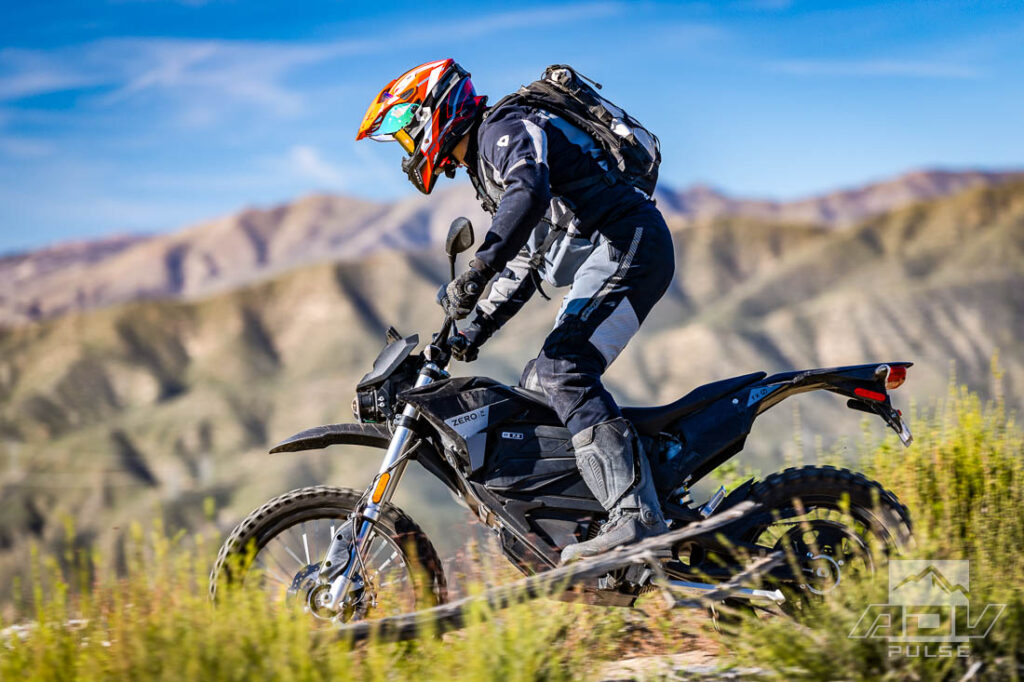
While the chassis of the FX makes it a decently capable off-road bike, the range and lack of quick-charging options limit its use as a utilitarian dual sport. Long 60-mile technical trail rides, like the ones I typically do on my 500, are just out of range. For riders who are using it as a fun commuter bike during the week and dabbling with casual trail rides on the weekend, it could be a compelling option though. If you’re sticking primarily to fire roads and more casual trails, there’s enough range for a 50+ mile loop, which is a big day for a lot of riders. However, if you don’t live close to the trails, you’re going to need something to transport the bike there.
Price is also a big consideration with this machine. At $12.5k there are a lot of great gas-powered dual sports you could own with similar or better capability on the trail and more range like a Kawasaki KLX300S, Suzuki DRZ-4S or Honda CRF450RL. So this bike may only make sense for those that have an appreciation for the unique riding experience that electric motorcycles offer. As well as those riders that don’t want to monkey around with a clutch, shifting gears, changing fluids, chain maintenance, adjusting valves, or paying hundreds of dollars a year at the gas pump… For those who’ve grown up on gas-powered machines, it might be hard to wrap your head around but as more and more young riders graduate from e-bikes, you can imagine a significant number of them will choose electric over gas.
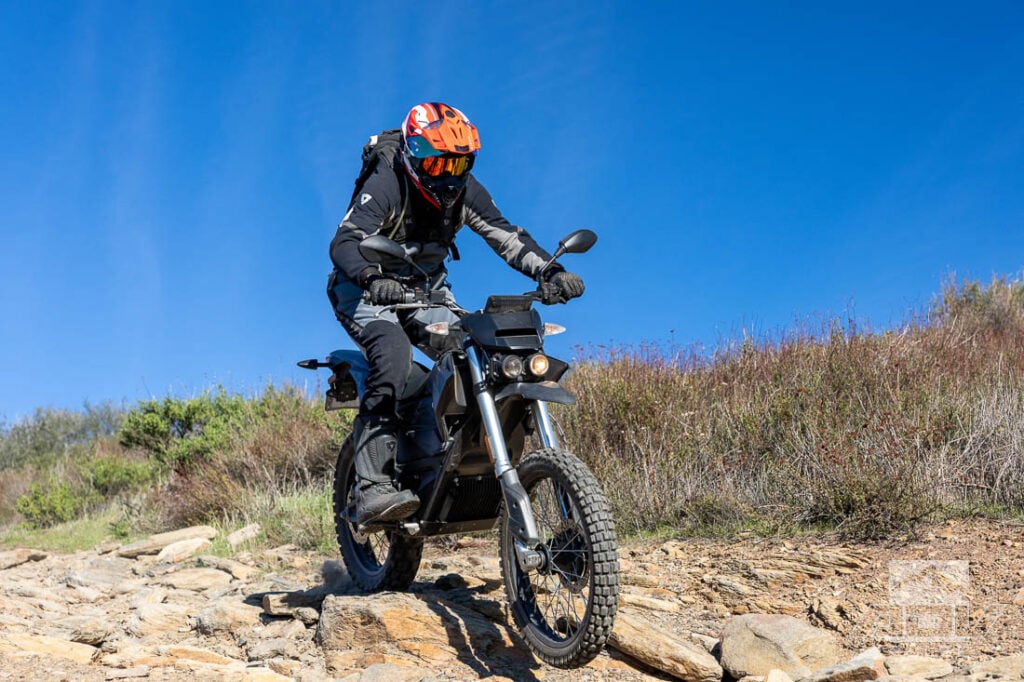
My feeling after spending some time with the bike is that it’s got more power than it needs. Perhaps, the same chassis with a smaller motor and a slightly larger battery would give it just enough usable range to get out on longer rides and have less anxiety about running out of juice. I’d gladly give up the FX’s lightning-quick acceleration to have 30 more miles of range in the dirt. I definitely enjoy the unique e-motorcycle riding experience though and it left me wanting more. While I’m not ready to give up my KTM 500 EXC-F’s space in the garage, I could see clearing some space next to it to squeeze in a bike like the FX.
Gear We Used
Jacket: REV’IT! Stratum GTX
Pants: REV’IT! Stratum GTX
Boots: REV’IT! Expedition GTX
Gloves: REV’IT! Massif
Helmet: Airoh Commander 2
Goggle: Scott Prospect
Zero FX Specs
| Range City: | 102 miles (164 km) |
| Low-Speed Range Highway, 55 mph (89 km/h) : | 65 miles (104 km) |
| High-Speed Range Highway, 70 mph (113 km/h) : | 57 miles (92 km) |
| Peak torque: | 78 ft-lb (106 Nm) |
| Peak power : | 46 hp (34 kW) @ 4,300 rpm |
| Top speed (max) : | 85 mph (137 km/h) |
| Top speed (sustained) : | 70 mph (121 km/h) |
| Motor Type: | Z-Force 75-5 passively air-cooled, high efficiency, radial flux, interior permanent magnet, brushless motor |
| Controller : | High efficiency, 550 amp, 3-phase brushless controller with regenerative deceleration |
| Power pack: | Z-Force Li-Ion intelligent integrated |
| Max capacity : | 7.2kWh |
| Nominal capacity : | 6.3 kWh |
| Charger type: | 650 W, integrated |
| Charge time (standard) : | 9.7 hours (100% charged) / 9.2 hours (95% charged) |
| With one accessory charger : | 4.1 hours (100% charged) / 3.6 hours (95% charged) |
| With max accessory chargers : | 1.8 hours (100% charged) / 1.3 hours (95% charged) |
| Input: | Standard 110 V or 220 V |
| Transmission: | Clutchless direct drive |
| Final drive: | 90T / 18T, Poly Chain HTD Carbon belt |
| Front suspension: | Showa 41 mm inverted cartridge forks, with adjustable spring preload, compression and rebound damping |
| Rear suspension: | Showa 40 mm piston, piggy-back reservoir shock with adjustable spring preload, compression and rebound damping |
| Front suspension travel : | 8.6 in (218 mm) |
| Rear suspension travel : | 8.94 in (227 mm) |
| Ground Clearance: | 12.0 in (305 mm) |
| Front brakes: | Bosch Gen 9 ABS, J-Juan dual piston floating caliper, 240 x 4.5 mm disc |
| Rear brakes: | Bosch Gen 9 ABS, J-Juan single piston floating caliper, 240 x 4.5 mm disc |
| Front tire: | Pirelli Scorpion MT 90 A/T 90/90-21 |
| Rear tire: | Pirelli Scorpion MT 90 A/T 120/80-18 |
| Front wheel: | 1.85 x 21 |
| Rear wheel: | 2.50 x 18 |
| Wheelbase : | 56.6 in (1,438 mm) |
| Seat height : | 34.7 in (881 mm) |
| Rake : | 25.4° |
| Trail : | 4.1 in (104 mm) |
| Curb weight: | 289 lb (131 kg) |
| Carrying capacity: | 341 lb (155 kg) |
| Equivalent fuel economy (city) : | 544 MPGe (0.43 l/100 km) |
| Typical cost to recharge $USD: | $0.81 |
| MSRP $USD: | $12,495 |
| Standard Warranty: | 2 years |
| Power pack warranty: | 5 years/unlimited miles |
Photos by Nic de Sena and Rob Dabney

Author: Rob Dabney
Rob Dabney started a lifelong obsession with motorcycles at the age of 15 when he purchased his first bike – a 1982 Honda MB5. Through his 20’s and 30’s he competed in off-road desert races, including the Baja 250, 500 and 1000. Eventually, his proclivity for exploration led him to dual sport and adventure riding. Rob’s never-ending quest to discover what’s around the next bend has taken him on Adventures in Latin America, Africa, Europe, Asia, and throughout the American West. As a moto journalist, he enjoys inspiring others to seek adventure across horizons both near and far.Related Stories
Related Stories
 Zero Brings Its Most Adventure-Ready Electric Dual Sport to US Zero Motorcycles has announced its updated 2020 electric bike lineup, featuring new colors,...
 Can-Am Origin Electric Dual Sport First Ride Review There’s no question electric cars have seen a remarkable rise in the last...
 BDR and Zero Join Forces To Grow E-Powered Adventure Riding Along with the launch of the new DSR/X electric adventure motorcycle, BDR and...
Popular Stories
Ducati’s Street‑Legal 450 Enduro Takes Shape Ahead Of 2026 Launch
Ducati’s push into off‑road competition is about ...

British Couple Riding Through Iran Receives Harsh Prison Sentence
When Craig and Lindsay Foreman set off from Londo...
Moto Morini’s 450cc Twin Adventure Bike Lands in the U.S.
Moto Morini’s long‑anticipated 450cc adventure ...
Yamaha’s Flagship Tenere 700 “World Raid” Is Coming To The US
Tenere fans rejoice! Yamaha is finally bringing...



Notify me of new posts via email
Had one. Loved it. Got rid of it. Regretted it. Getting another one.