
Honda Transalp Quietly Received Key Off-Road Upgrades For 2026
The midsize ADV gets some updates for the new year, one we’re most excited about.

The 2026 Honda XL750 Transalp was unveiled at EICMA earlier this month with little fanfare, overshadowed by splashier unveilings of all-new adventure machines. Yet for riders paying attention, Honda’s midweight ADV contender quietly gained significant upgrades that will make it an even more formidable competitor in the hotly contested middleweight segment.
In 2025, the Transalp had already taken a noticeable step forward with a range of targeted upgrades. Honda sharpened the styling with Africa Twin-inspired bodywork, added a new 5-inch TFT display with smartphone connectivity and turn-by-turn navigation, and re-tuned the suspension damping for better bump absorption and plushness. The range of changes helped the bike shed its “Plain Jane” reputation to give it a more aggressive look, along with improved off-road characteristics.
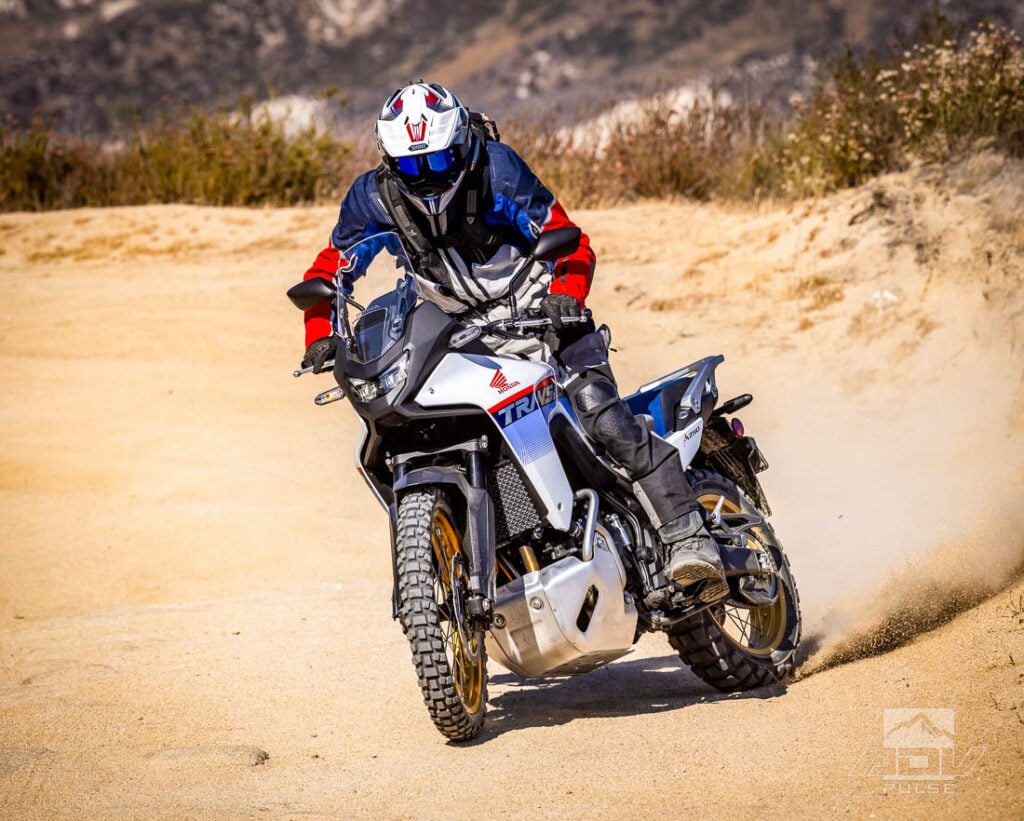
For 2026, Honda continues building on a solid foundation with more incremental updates. The biggest change of the bunch has to be the availability of the optional Honda E-Clutch system, a semi-automatic clutch that allows riders to start, stop, and shift without touching the lever, while still maintaining manual control with a flick of a switch. The E-Clutch integrates with Throttle By Wire to blip the throttle automatically, smoothing downshifts and ultra-smooth upshifts when the rear wheel is spinning off-road — both crucial for consistent performance and improved ridability in the dirt. The system adds 6 kg (13 lbs) to the bike, a modest penalty for the convenience it offers. A standard clutch version of the bike will still be available for those who prefer it.
Another practical addition is a factory skid plate now fitted as standard on E-Clutch models. Constructed from 2.5 mm aluminum with a full wraparound design, it provides protection for the sump and exhaust system against rocks and debris.

The most significant news for off-road riders, however, is the arrival of fully-adjustable Showa suspension. The 43 mm USD fork continues to offer 7.9 inches of travel, while the rear shock delivers 7.5 inches through Honda’s Pro-Link system. However, both front and rear now feature compression and rebound damping adjustment, allowing riders to fine-tune suspension performance to match trail conditions and riding style.


In our 2025 test, the re-tuned damping settings made the Transalp more compliant and capable in rocky terrain. However, the lack of adjustable suspension has always been a limitation for the model. Now with full adjustability front and rear for 2026, the gap is narrowed to its primary competition in the segment — the Yamaha Tenere 700.
The 463-pound Transalp still gives up 0.4 inch of travel to the 459-pound T7, but counters with a nearly one-inch lower seat height and a stronger engine output — over 90 horsepower (EU version) and 55 lb-ft of torque from the 755cc parallel twin, compared to the Yamaha’s 72 hp and 50 lb-ft. Factor in the Transalp’s pricing advantage (about $1,000 less as of 2025), and Honda’s strategy starts to take shape: incremental upgrades aimed at making the bike more competitive without losing its reputation for versatility and value.

Overall, Honda’s midsize ADV remains a well-rounded package. With the addition of steady refinements like the E-Clutch option, a standard skid plate, and fully adjustable suspension, the 2026 Transalp closing in on the class leaders while retaining its approachable character.
In addition to the component upgrades, 2026 will see three new color schemes with updated graphics: Ross White Tricolour Mat Ballistic Black Metallic; and Pearl Deep Mud Gray. Pricing, availability and colors for the U.S. market have not yet been announced. We’ll report back with more details as we receive it.
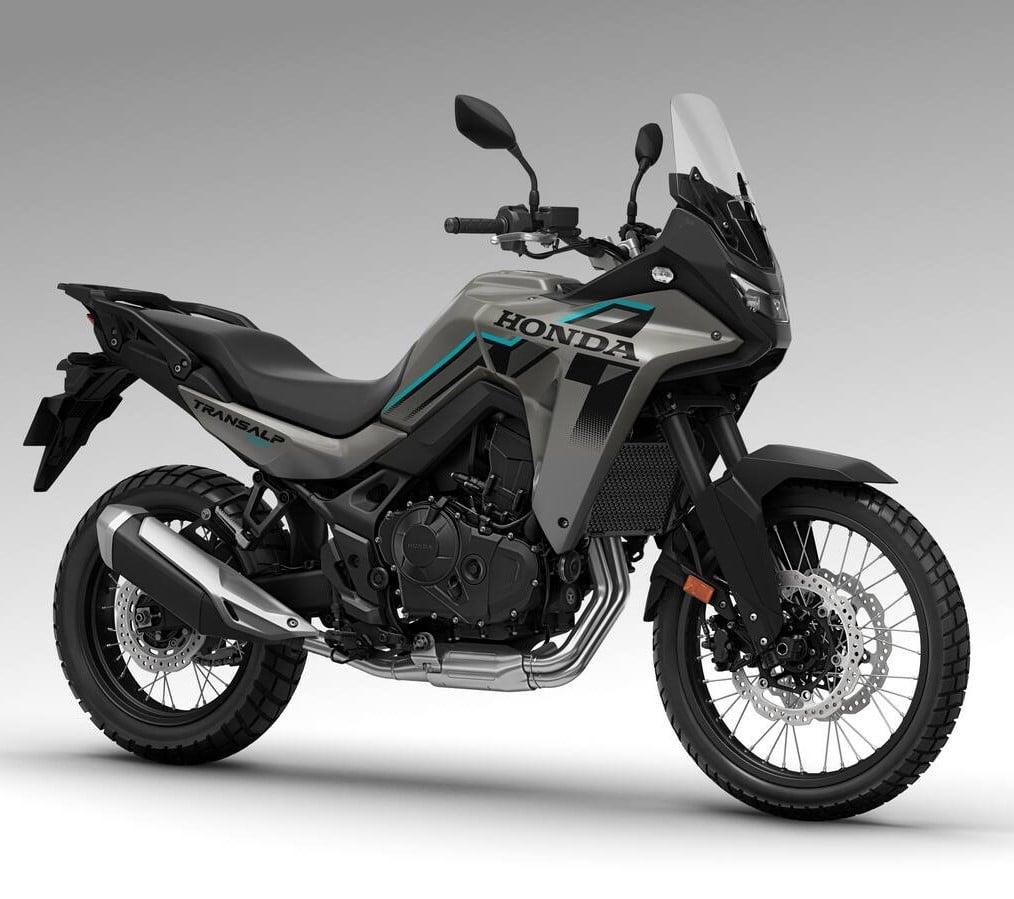


2026 XL750 Transalp Specs
| XL750 Transalp | XL750 Transalp E‑Clutch | |
| Engine Type: | Liquid‑cooled SOHC 4‑stroke 8‑valve Parallel Twin, 270° crank | Liquid‑cooled SOHC 4‑stroke 8‑valve Parallel Twin, 270° crank |
| Displacement: | 755 cc | 755 cc |
| Bore × Stroke: | 87 × 63.5 mm (3.43 × 2.5 in) | 87 × 63.5 mm (3.43 × 2.5 in) |
| Compression Ratio: | 11.0:1 | 11.0:1 |
| Max Power: | 67.5 kW @ 9,500 rpm (90 hp) | 67.5 kW @ 9,500 rpm (90 hp) |
| Max Torque: | 75 Nm @ 7,250 rpm (55 lb‑ft) | 75 Nm @ 7,250 rpm (55 lb‑ft) |
| Stationary Sound Level: | 95 dB | 95 dB |
| Max Speed: | 195 km/h (121 mph) | 195 km/h (121 mph) |
| Oil Capacity: | 3.9 L (4.1 qt) | 3.9 L (4.1 qt) |
| Starter: | Electric | Electric |
| Fuel System: | PGM‑FI Fuel Injection | PGM‑FI Fuel Injection |
| Fuel Tank: | 16.9 L (4.5 gal) | 16.9 L (4.5 gal) |
| CO₂ Emissions (WMTC): | 102 g/km | 102 g/km |
| Fuel Consumption: | 4.3 L/100 km (54.7 mpg US) | 4.3 L/100 km (54.7 mpg US) |
| Battery: | 12 V, 9.1 Ah AGM | 12 V, 9.1 Ah AGM |
| Clutch: | Wet multi‑plate, assist/slipper | Wet multi‑plate, assist/slipper + Honda E‑Clutch |
| Transmission: | 6‑speed manual | 6‑speed manual with Honda E‑Clutch |
| Final Drive: | Chain | Chain |
| Frame: | Diamond steel | Diamond steel |
| Dimensions (L × W × H): | 2,325 × 838 × 1,455 mm (91.5 × 33 × 57.3 in) | 2,325 × 838 × 1,455 mm (91.5 × 33 × 57.3 in) |
| Wheelbase: | 1,560 mm (61.4 in) | 1,560 mm (61.4 in) |
| Caster / Trail: | 27° / 111 mm (4.4 in) | 27° / 111 mm (4.4 in) |
| Seat Height: | 850 mm (33.5 in) | 850 mm (33.5 in) |
| Ground Clearance: | 210 mm (8.3 in) | 210 mm (8.3 in) |
| Kerb Weight: | 210 kg (463 lbs) | 216 kg (476 lbs) |
| Turning Radius: | 2.6 m (8.5 ft) | 2.6 m (8.5 ft) |
| Front Suspension: | Showa 43 mm SFF‑CA USD, 200 mm (7.9 in) travel | Showa 43 mm SFF‑CA USD, 200 mm (7.9 in) travel; Fully adjustable. |
| Rear Suspension: | Pro‑Link monoshock, 190 mm (7.5 in) travel | Pro‑Link monoshock, 190 mm (7.5 in) travel; Fully adjustable. |
| Front Wheel: | 21 × 2.15 in stainless spoke, aluminium rim, tube type | 21 × 2.15 in stainless spoke, aluminium rim, tube type |
| Rear Wheel: | 18 × 4.00 in stainless spoke, aluminium rim, tube type | 18 × 4.00 in stainless spoke, aluminium rim, tube type |
| Front Tire: | 90/90‑21M/C 54H | 90/90‑21M/C 54H |
| Rear Tire: | 150/70R18M/C 70H | 150/70R18M/C 70H |
| ABS: | 2‑channel ABS (rear can be deactivated) | 2‑channel ABS (rear can be deactivated) |
| Front Brakes: | Dual 310 mm floating discs, 2‑piston calipers | Dual 310 mm floating discs, 2‑piston calipers |
| Rear Brake: | 256 mm disc, 1‑piston caliper | 256 mm disc, 1‑piston caliper |
| Instruments: | 5‑in TFT multi‑info display | 5‑in TFT multi‑info display |
| Lighting: | LED headlight & taillight | LED headlight & taillight |
| Connectivity: | Honda RoadSync | Honda RoadSync |
| USB: | Type‑C | Type‑C |
| Indicators: | Auto‑cancel, ESS (Emergency Stop Signal) | Auto‑cancel, ESS (Emergency Stop Signal) |
| Security: | HISS (Honda Ignition Security System) | HISS (Honda Ignition Security System) |
| Riding Modes: | Sport, Standard, Rain, Gravel, User1/User2 | Sport, Standard, Rain, Gravel, User1/User2 |
| HSTC: | 3 levels + Off | 3 levels + Off |

Author: Rob Dabney
Rob Dabney started a lifelong obsession with motorcycles at the age of 15 when he purchased his first bike – a 1982 Honda MB5. Through his 20’s and 30’s he competed in off-road desert races, including the Baja 250, 500 and 1000. Eventually, his proclivity for exploration led him to dual sport and adventure riding. Rob’s never-ending quest to discover what’s around the next bend has taken him on Adventures in Latin America, Africa, Europe, Asia, and throughout the American West. As a moto journalist, he enjoys inspiring others to seek adventure across horizons both near and far.Related Stories
Related Stories
 2025 Honda Transalp First Ride Review When Honda revived the legendary Transalp name in 2023, it sparked a wave...
 Watch: 2024 Honda XL750 Transalp Tested The Transalp returns to the Honda lineup after a three-decades-long absence in the...
 2024 Honda XL750 Transalp First Ride Review Honda brings the Transalp (TA) back to life after more than a decade...
Popular Stories

5 Small‑Bore Adventure Bikes That Aren’t Buzzy On The Highway
Small‑bore adventure bikes in the 300–500cc range...
Bultaco Staging Comeback With Budget-Friendly 300cc ADV Bike
Bultaco is officially back in the motorcycle busi...
BMW Announces US Pricing And More Details On The 2027 F 450 GS
BMW has released new details for the 2027 F 450 G...
KTM Announces Specs And Availability Of New 690 Rally Model
KTM is expanding its LC4 lineup with the introduc...


Notify me of new posts via email
This will probably my next bike! I’ll ride out the stock suspension until I blow it out. Won’t be getting the E-clutch version. Good job Honda!
Wow – still no tubeless wheelset.
The only reason for stopping me to buy the Transalp is the Tubed Tires.
What a shame that there is not Tubeless” upgrade for 2026.
I’ll keep waiting maybe in the future Honda decides to change…..
Honda: Please offer cruise control for the Transalp!
And once again Honda is too ignorant to add tubeless tires and cruise control